The Layers of “The Unfeathered Bird”

The Unfeathered Bird by Katrina van Grouw

My copy of Katrina van Grouw‘s The Unfeathered Bird demanded to be placed on my coffee table. In the same way that everything about a cheetah says fast, everything about The Unfeathered Bird says coffee table book. There are 385 illustrations of 200 bird species. It is 287 pages long and weighs a couple of kilograms. When a book like that asks space on your coffee table, you ask “how much space?”. Fortunately, I have a sturdy coffee table.

I also have two small children (hence the sturdy coffee table). As a result, my first encounter with the content between the covers was not the orderly perusal with wine I had been planning for that night. Instead, it started with my 4-year-old, The Frogger, opening The Unfeathered Bird and asking, while staring at an immaculate illustration of a skinned bird foot, “Daddy, what is this book about?”

“It’s a book about birds. It shows you the insides of birds so we can learn how they work.” Continue reading “The Layers of “The Unfeathered Bird””
The Art of “The Unfeathered Bird”

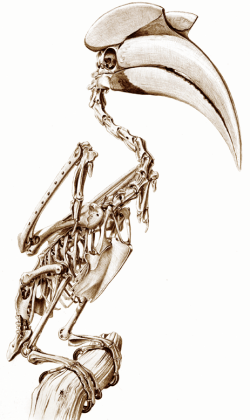
Skeleton of a Great Hornbill by Katrina von Grouw - The Unfeathered Bird (2012 Princeton University Press - Used with Permission)
Skeleton of a Great Hornbill by Katrina von Grouw – The Unfeathered Bird (2012 Princeton University Press – Used with Permission)

Katrina van Grouw’s The Unfeathered Bird is curious hybrid – not a textbook, not quite an art book. Forget definitions, it is a rich and beautiful work with many rewards for readers.

I approached this book as a visual artist and a decidedly non-expert reader, and I will admit an initial bias against it. I love color. I was convinced that a coffee-table book of birds drawn without their feathers was like a book on ice cream that featured only the cones.

I was wrong. Continue reading “The Art of “The Unfeathered Bird””

The Birds of “The Unfeathered Bird”

Rebecca earned her master’s degree with a focus in avian ecology at Binghamton University, worked at Cornell’s Lab of Ornithology, has conducted international research on birds overseas, and completed her PhD in avian physiology the University of Memphis. She now teaches biology at the South Carolina Governor’s School for Science & Math.

After a certain high level of technical skill is achieved, science and art tend to coalesce in esthetics, plasticity, and form. The greatest scientists are always artists as well. – Albert Einstein

Birdsketch by Rebecca Heiss (All Rights Reserved)I became a biologist for a reason. It was not that I was particularly good at the sciences, but that I was terrible at art. My stick figures were never going to pay the rent. Perhaps lacking the drive to master any one trade, I’ve dabbled, becoming proficient in a smattering of largely scientific endeavors. It is little wonder then, that Katrina van Grouw’s mastery of multiple fields makes me feel a twinge of jealousy. Continue reading “The Birds of “The Unfeathered Bird””

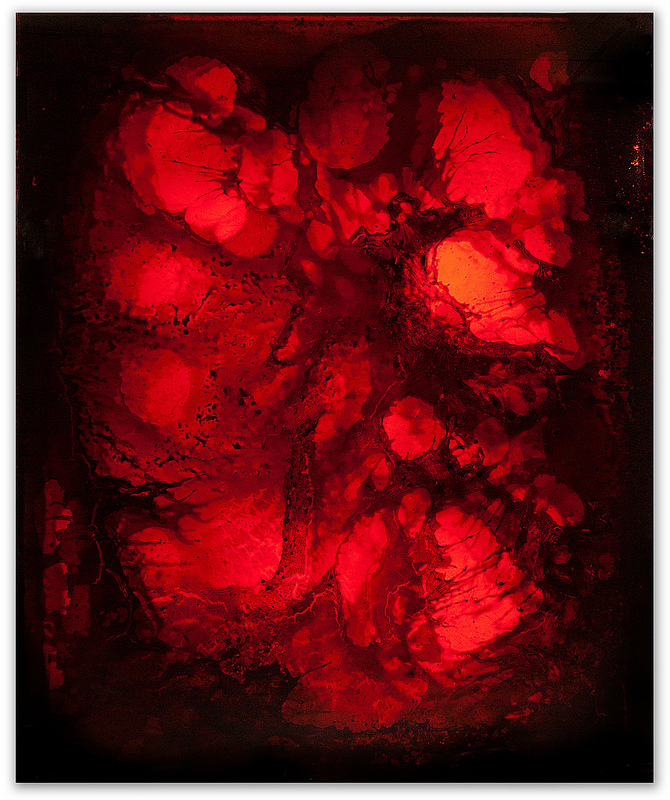
The Art of Science: The Bloody Brilliance of Jordan Eagles

Life Force, 2012
Life Force, 2012

I get no kick from old bones
Nails, skin and hair
No, I really don’t care
Just give me that trickle, that flood
‘Cause I get a kick out of blood.

OK, so maybe that’s not quite how that song goes.  I was inspired by bravura bloodwork of this week’s Art of Science pick, Jordan Eagles. Continue reading “The Art of Science: The Bloody Brilliance of Jordan Eagles”

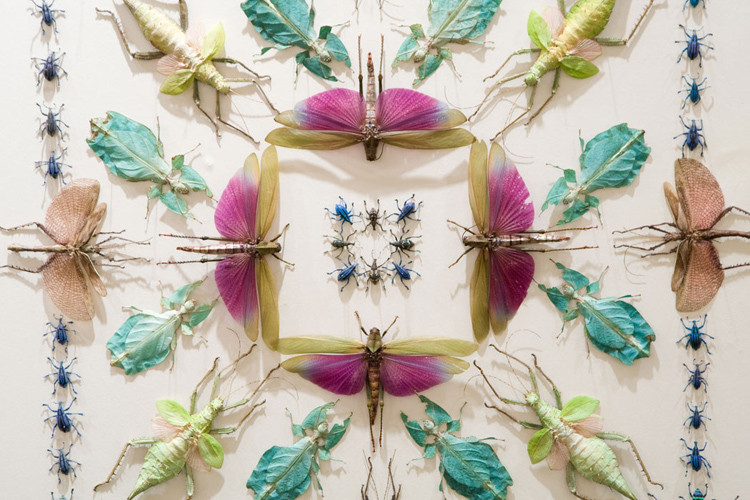
The Art of Science: The Shimmering Insects of Jennifer Angus

Jennifer Angus, Insecta Fantasia

Bugs crawling up the walls are the stuff of nightmares for many, but they become stunning art in the hands of Jennifer Angus. A professor at the University of Wisconsin-Madison, Angus has for years used real, dead insects as her primary artistic medium. Her compositions, which are usually pinned to gallery walls, often refer to Victorian decorative motifs, which in turn recall the insect-collecting habits of 19th century naturalists.

Like them, she gathers her insects from around the world, particularly Thailand and Malaysia. While she notes that none of the insects she uses in her work are endangered species, she hopes that her art will spur an interest in both entomology and rainforest preservation in her audience. The eye-popping colors of her artwork are all natural, she says – she does not enhance the insects with paints or dyes. Angus’ work is on exhibit at the Jack Olson Gallery at Northern Illinois University through February 28, and you can see more on her website.

Photo via Wired.com