The Art of Science: Emma McNally’s Cunning Plots

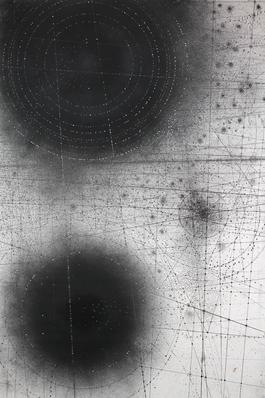
Carbon Sound Field, 2010

Emma McNally makes pencil drawings on paper that remind everyone of something – star maps, city grids, network diagrams, physics experiments. In fact, they are none of these things. Inspired by visualizations of complex systems but not based on actual data, they spring entirely from her imagination. And that’s cool too. Her page at the Trinity Contemporary Gallery site has more.

The Art of Science: Build Your Own Species

from Cephalopodoptera, 2012

One way around the difficulties of traditional scientific illustration?  Invent your own species, then nobody can argue with your rendering of the details. Vladimir Stankovic, a Serbian-born illustrator who now lives in Finland, regularly dreams up new species, and even a whole new order, Cephalopodoptera, “a link between molluscs and insects” that live in underwater caves.

Stankovic says he’s inspired by Klimt and Dali, but his work shows the clear influence of Haeckel as well – if Haeckel had used photoshop to turn his paintings into animated gifs. You can see an online gallery of Stankovic’s work here and buy one for your wall at his etsy shop.

Old Maps, Ingenuity, and the Internet

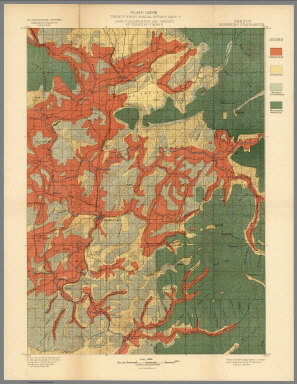
Plate CXXVIII. Roseburg Quadrangle, Oregon, Land Classification and Density of Standing Timber (Cartography Associates CC BY-NC-SA)

I love old maps. Many are wildly inaccurate. Many are fanciful. Many are surprisingly well done. In our era of Google Maps and GPS, it is easy to forget that early mapmakers could not easily see what they were drawing from above. The combination of skills, tricks, rules-of-thumb, and artistry that goes into cartography bends the mind.

David Rumsey has collected maps for decades and decided to donate his map collection to the Internet. Now, the internet has one more thing with which it can distract me.

*Hat tip to Rebecca Rosen.


The Art of Science: Who’ll Stop the Rain

rain

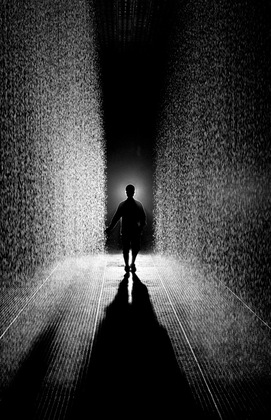
Every movie villain worth his salt schemes to control the weather; now that experience is available to New York City museum-goers. The Museum Of Modern Art’s Rain Room, open from May 12 to July 28, is a “large-scale environment” which will allow visitors to “experience how it might feel to control the rain.”  The work, by design group Random International, consists of a structure that pours down water like rain, except when its sensors detect the presence of a human body.

MoMA says that the piece “also invites visitors to explore what role science, technology, and human ingenuity can play in stabilizing our environment.” Well maybe – although I doubt that creating blatantly fake environments which allow humans to “control nature” does much to advance our thinking about our real relationship with, say, weather and climate. Let’s just call it an undoubtedly cool piece of techno-art that will be a magnet for New Yorkers and tourists alike this summer.

The Art of Science: Cicada Invasion

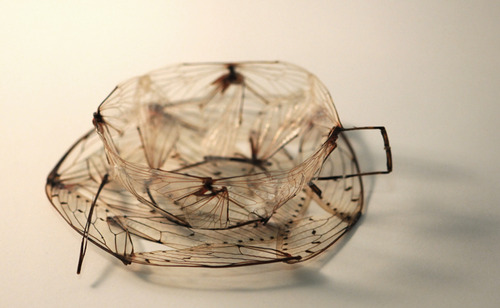
cicadacup

The eastern part of the US is bracing for hundreds of millions of visitors this spring – the Brood II cicadas, which emerge from underground only every 17 years. The “coming frenzy of sex and death,” as the Washington Post put it, is the largest since Brood X emerged in the summer of 2004. That year, many artists from the area used the cicadas’ discarded carapaces, which lay on the ground in thousands all over the region, in their artwork.  So I went to look for cicada-based art, and found a few interesting things. Continue reading “The Art of Science: Cicada Invasion”