The Art of Science: Both Sides of the Cloud

Yuriko Yamaguchi, Cloud, 2014 (detail)

Yuriko Yamaguchi’s ethereal sculptures are mostly made of wire and resin, but she has also included LED lights, wood, minerals, and bits of electronics. Reminiscent of organic shapes such as clouds, swarms, and neural networks, they symbolize the interconnectedness of all human and organic systems.

Yamaguchi says that her work was influenced by the work of physicist and systems theorist Fritjof Capra, whose book “The Web of Life” explored the tension between the part and the whole in many different systems.

The artist described one of her recent sculptures rather poetically:  “Creative energy is in a way like rain that comes down from the sky when the accumulated humidity can no longer remain suspended in the air and drops to the earth.”

The cloudlike form refers not only to atmospheric phenomena but to the modern, technological meaning of “the cloud”, emphasizing Yamaguchi’s belief that science, nature and technology are intimately intertwined.

Several pieces of her recent work are on display in “Interconnected: Science, Nature, and Technologies” at the Adamson Gallery in Washington, DC through August 31.

You can see more of her work on her website.


The Art of Science: Most Agreeable Developments

janeIf Jane Austen blogged about science art, she would note that it is a truth universally acknowledged, that artists and scientists are rarely found in the same place. You don’t often find an artist in a lab, and you seldom see a scientist in a gallery. (Yes, yes, I know, there are exceptions! It’s not polite to interrupt Jane Austen.)

There are many reasons for this, involving various permutations of, well, let’s not say pride or prejudice exactly, but perhaps a difference of sensibilities.  Now comes an opportunity to get around at least a few of these, by having artists meet scientists where they are.

Two major annual meetings of scientific organizations, The American Public Health Association and the Society for Neuroscience, have created opportunities for science artists to display and sell their work to their thousands of attendees. Rather remarkably, both take place on exactly the same dates – November 15-19, 2014.

The annual meeting of the American Public Health Association (APHA), held this year in New Orleans, attracts 12,000 attendees in a wide variety of fields related to public health. As part of a new initiative called Art @ The Expo, they are looking for 20 artists or crafters whose work is health, medicine or science related to show and vend at the meeting. The $200 booth fee for 3 days is a fraction of what APHA charges its large commercial exhibitors.  More information and guidelines for applicants are here.

Do you delight in dendrites? The Art of Neuroscience, part of the annual meeting of the Society for Neuroscience (SfN), seeks artists whose work is directly related to neuroscience. For a $300 fee, artists can show their work at the gigantic gathering of some 30,000 neuroscientists in Washington, DC. Interested artists can find more information and a prospectus here  – the deadline for applications is August 29.

It’s really encouraging to see large scientific organizations take steps to include independent artists and crafters in their events. AAAS, ACS, ASM, please take note. If, to quote Jane Austen, “one half of the world cannot understand the pleasures of the other,” at least some people are making an effort to provide a peek over the fence. Perhaps others may be persuaded?

Perrin, Ireland

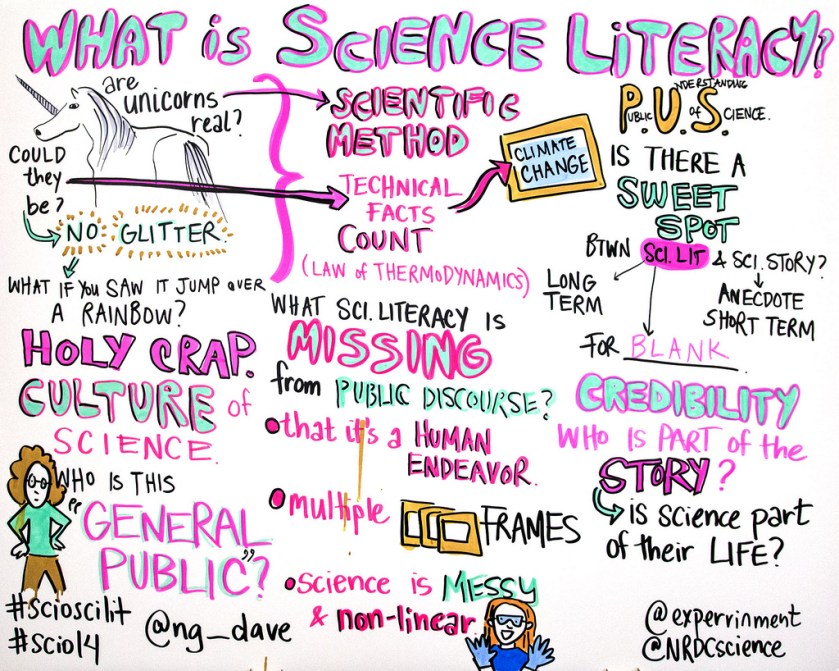
I checked on Google Maps and Perrin, Ireland does not seem to exist*; but the science artist Perrin R. Ireland does. She creates amazing resources for communicating science for the Natural Resources Defense Council.

She also has her own website that you should examine closely, regardless of how much free time you claim to not have. Perrin is a talented artist, creative thinker, and a mad genius when it comes to the art of “scribing”.

Art by Perrin R Ireland; Photo by Russ Creech (All Rights Reserved; Used with Permission)

*Though there is a Perrin Way in Lusk, Ireland.

The Art of Science: Karen Russell’s Bad Plant Romance

badgraft
Photo by Michael Marcelle for The New Yorker

My art of science posts usually focus on visual art, but this week I stumbled upon a beautiful example of a much rarer species – a short story thoroughly saturated with science. “The Bad Graft”, a story by Karen Russell in this week’s New Yorker, tells the story of a sort of love triangle between a man, a woman and a plant. Russell, best known for her novel Swamplandia, knows her way around exotic flora.

This story is set in the Mojave Desert, where a young couple, Angie and Andy, have come to visit Joshua Tree National Park. The Joshua tree, aka Yucca brevifolia, is a tough, twisted plant with painfully spiky leaves. Angie and Andy happen to arrive in the park during what a ranger calls “a pulse event” during which yucca moths pollinate the trees. “You think you’re in love? The moths are smitten. In all my years, I’ve seen nothing to rival it. It’s a goddam orgy in the canyon.”

The ranger goes on to describe the obligate relationship between the moths and the Joshua trees, each species entirely dependent on the other. He explains that the trees may be on the brink of extinction, and that the current “orgy” may be the ancient species’ “Hail Mary pass” or last shot at survival.

The trees may be prepared to go even further. The “Bad Graft” of the title occurs soon after the couple’s meeting with the ranger. Russell describes it in prose that suggests an earthquake or a war: “The yucca moths arrive like living winds, swirling through Black Rock Canyon. Blossoms detonate. Pollen heaves up. Then the Joshua tree sheds a fantastic sum of itself.”  Angie pricks her finger on one of the plant’s spines “and becomes an entire new creature.”

I won’t spoil the rest of the plot. I’ll only say that Russell has given serious thought to what it would be like to have a hardy desert plant take over the core of your being. She also thoroughly explores the metaphorical aspects of convergent evolution, obligate relationships and the idea of rootedness in both people and plants.

You can read “The Bad Graft” here – it’s subscriber-only, but you can get a free month’s trial that will unlock this little treasure.


Mitochondrial Royalty

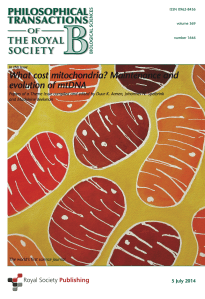
front-matterOur own Michele Banks provided the cover art for a mitochondria themed issue of Philosophical Transactions of the Royal Society B (B is for Biological Sciences). The Royal Society traces its roots back to 1660. Philosophical Transactions dates back to 1665 and the splitting into and dates to 1887

We could not be prouder of Michele for contributing to the merger of art with this long scientific tradition, nor could we be prouder of the Royal Society for showing excellent taste.