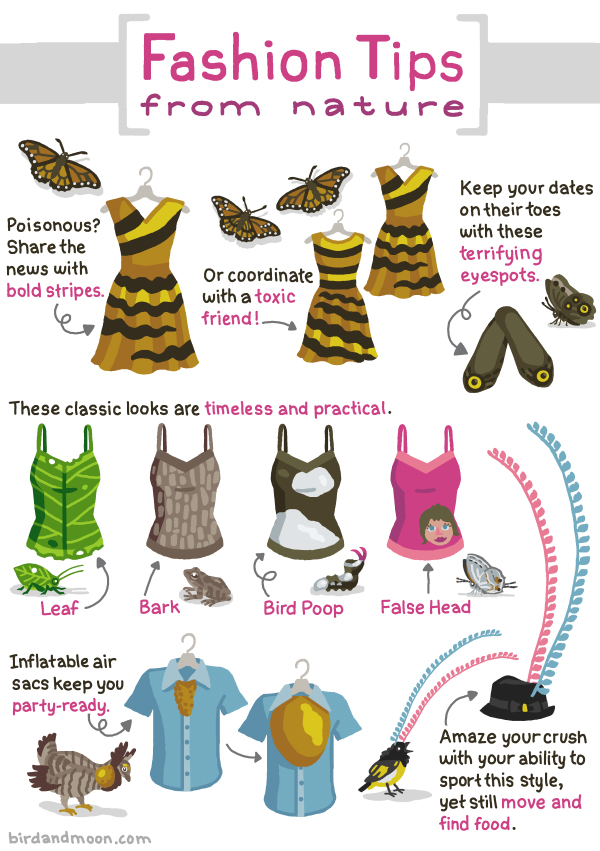
Rosemary Mosco is a naturalist, illustrator and science communicator who has seamlessly merged her scientific and artistic interests into a range of projects, most notably her Bird and Moon science comics.
Mosco’s academic background as a field naturalist, her obvious love of nature in all its forms, and her sunny sense of humor and cheerful style combine to create informative content that feels effortless.
Her work is featured in an exhibition called Quirks of Nature, running through June 8 at the Museum of the Earth in Ithaca, NY. The exhibition pairs her comics and illustrations with fossils, taxidermy, live animals, and more. Mosco provides commentary on her drawings and the inspiration behind them – from working at a bird rehabilitation center as a kid to suffering through an awkward first date – while experts explain the hard science behind each comic.
If you can’t make it to Ithaca, you can see more of Rosemary Mosco’s work at her website and support her work via Patreon.
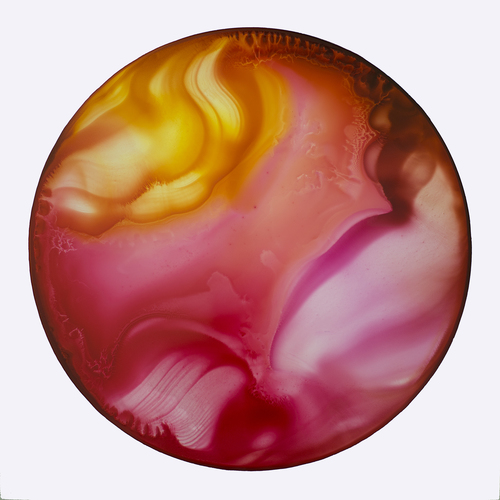
John Sabraw, Chroma S1 12, 2013, Mixed media on aluminum composite panel
Need proof that you can make art out of almost anything? Artist John Sabraw creates beautiful paintings using the byproducts of acid mine drainage. Sabraw, an artist and professor at Ohio University, works together with OU chemists and engineers to turn the toxic runoff from abandoned mines into pigments, which he then makes into paints and uses to create his artwork.
Ohio has miles of abandoned coal mines filled with metal dust. The mines eventually fill with water, which becomes acidic as the oxygen in it reacts with sulfide minerals in the rock, and picks up high concentrations of iron and aluminum. This water then spills out into streams, polluting them and killing wildlife.
An environmental engineering professor at OU, Guy Riefler, worked with some students to develop a novel approach to this problem – to take this toxic runoff and turn it into paint. This is not as crazy as it sounds – many commercial red and yellow paints are made from ferric oxyhydroxides, one of the major components of the polluted water. Riefler and his students worked on processing and refining the runoff into pigment (there’s a video here that goes through the main steps). Then they approached Sabraw, who had experience in making paints from scratch, to be a product tester.
The rest is not so much history as, well, science and art. Sabraw created a range of both oil and water-based paints from the runoff and now uses them to make all of his paintings, which have been featured in numerous gallery shows. You can see his work in an upcoming show at Chicago’s McCormick Gallery from March 6- April 25, 2015 or at his website.
Riefler and Sabraw are continuing to work on the paints, and hope to create a viable commercial line, with proceeds going to clean up polluted streams in Ohio.
The tree in the center was printed with a traditional 3D printing algorithm, while the others were made with the new pyramid technique
Little plastic Christmas trees don’t really count as art, but the science and math behind this one is pretty interesting, so we’ll let the deeper questions of aesthetics and meaning slide just this once.
Computer Science researcher Richard Zhang of Canada’s Simon Fraser University printed the tree as a demonstration of a newly developed 3D printing algorithm that has potential applications far beyond seasonal tchotchkes.
“Zhang is solving a real-life problem: saving waste. Printing an object with overhanging parts, like a tree branch, requires the deposition of extra material below to support the top part through the printing process. At the end, this material is cut away and trashed. The answer, according to Zhang, is in using pyramidal components.”
“Decomposing a complex shape into simpler primitives is one of the most fundamental geometry problems,” Zhang and his team write in a recent paper. “The main motivation is that most computation and manipulation tasks can be more efficiently executed when the shapes are simple.”
And pyramids offer an elegant solution, because, Zhang says, pyramids are 2.5D. (I’ll give you a second to collect your brain cells from the floor)
Byrne explains: “Two-and-a-half dimensions is a concept used in machining (and computer graphics, with a different meaning) to describe an object with no overhangs. It only has a top, and can be viewed as a projection of 2D flatness into the third dimension.”
There’s lots more info about the science and math behind the printable pyramids in Byrne’s article and in Zhang’s paper.
Last week, I posted on the biological elegance of using the simple building blocks of Legos to create complexity in objects using a crow built by nobu_tary as an example. Another creation of nobu_tary illustrates how few of those simple building blocks are necessary, if you look at them from an unanticipated point of view.
I give you a chicken…
“LEGO Chicken” by nobu_tary (All Rights Reserved; Used with Permission)
*For the unitiated, the chicken is created using two Lego mini-figure hair pieces.



 The Finch and Pea