Intergalactic Planetary

HD_40307g_20x30A few weeks ago, NASA’s Jet Propulsion Laboratory (JPL) released a series of three retro-travel posters promoting the exoplanet discoveries of the Kepler Space Telescope. The focus on travel to other planets and the style of the posters reminded me immediately of the artwork used by the Intergalactic Travel Bureau (art created by Steve Thomas) in their outreach. The Intergalactic Travel Bureau uses Thomas’ art in combination with in-person interactions with performers playing the part of a space travel agent to engage and excite audiences.

While the retro-poster concept is far from unique, the use of the phrase “Exoplanet Travel Bureau” made me wonder if the folks at JPL were inspired by the Intergalactic Travel Bureau project or if they had stumbled onto a similar idea independently. So I asked them; and they actually answered.

The concept for JPL’s posters was developed by David Delgado. Delgado collaborated with Joby Harris and Dan Goods to create the posters, according to Elizabeth Landau (JPL Media Relations Specialist). Joby Harris* said:

The existing posters by other artists out there were not inspiration for ours, but rather confirmation that our posters in progress would be well received.

While I’m a bit disappointed that the JPL team was unaware of Steve Thomas’ posters (the Intergalactic Travel Bureau has also received NASA funding), it is admittedly difficult to be aware of everything on the Internet these days. I do hope that the creative convergence of JPL and the Intergalactic Travel Bureau might lead to creative cooperation on science outreach efforts in the future.


Art of Science: A Moth’s Brief Life in Art

elsabe-dixon-event-image

Artist Elsabé Dixon grew up raising silkworms in cardboard boxes as a child in South Africa.  Now based in Virginia, Dixon has made her childhood hobby the source of her art, now on display in a unique residency and installation called LIVE/LIFE at Arlington’s Artisphere through February 22.

In the Artisphere studio, Dixon and helpers first constructed an environment for domesticated silkworms (Bombyx mori) to live out a life cycle – hatching from eggs to caterpillars, eating mulberry leaves, spinning cocoons, pupating, mating and dying – and then created sculpture using what was left behind, including twigs, empty cocoons, salt and even silkworm poop.

Detail from LIVE/LIFE, Elsabe Dixon, Mixed Media, 2014-15

Dixon sees the life cycle of the Bombyx mori – the only truly domesticated insect in the world – as a means of investigating many aspects of life. The first and most obvious is the ephemeral and ever-changing nature of life, but the work examines many other issues, including our relationships with society, nature and the built environment.

There are no barriers between the insects and the audience here. Visitors in the earlier months of the residency were free to touch the caterpillars and the moths. When I visited earlier in January, the moths were all dead, but I was able to touch the silk cocoons left behind.

The sculptural installation that Dixon has constructed, first for the silkworms to live in and then using their products and detritus, is based on microscopic photographs of silkworm particles. Made from materials including rubber, cut-up cardboard paper towel  tubes, discarded silk cocoons, mulberry branches and, yes, piles of caterpillar poop, the installation looks organic, natural, and utterly at home in its modern-art setting.

LIVE/LIFE is open to the public Thursday and Friday evenings as well as Sunday afternoons, when the artist welcomes visitors to join in conversations with her and others in the field of art, medicine, engineering and food production.

The Art of Science: Transparency vs. Openness

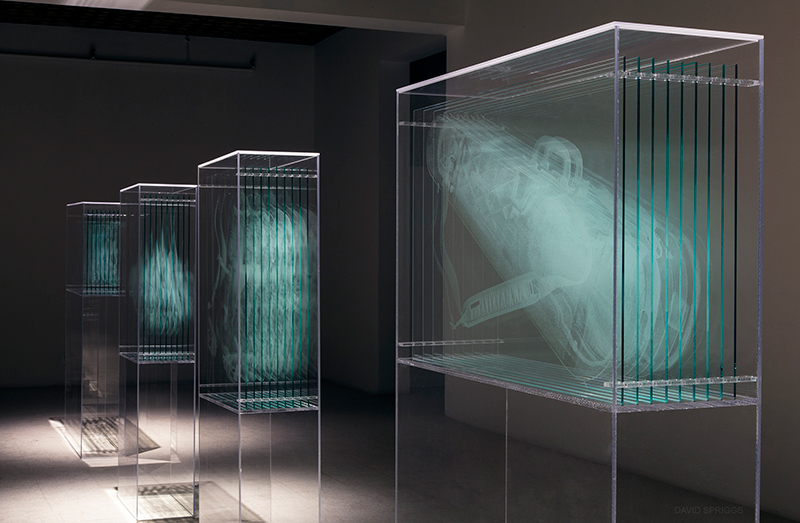
David Spriggs, Profile, Type A - Briefcase, 2014, Glass
David Spriggs, Profile, Type A – Briefcase, 2014, Glass and Lucite

Transparency, both physical and metaphorical, is the central preoccupation of David Spriggs’ artwork. In his 2014 exhibition, Transparency Report, he took classic 21st-century images of personal possessions inside a security scanner and turned them into haunting and gorgeously crafted art.

Spriggs creates his artwork by layering  images in space – in this case by engraving multiple sheets of glass which are displayed in spaced layers in lucite cases to reveal the three-dimensional forms.  While we generally link the idea of transparency with openness and honesty, these works reveal a darker side of transparency, in which individuals give governments and corporations the right to literally see through us and our personal belongings.

Spriggs will further explore the intersection of optics and surveillance in an upcoming show entitled Prism – referring to both the optical apparatus and the NSA surveillance program – from January 29 to May 9 at Montreal’s Arsenal Contemporary Arts.

Installation view from David Spriggs, Transparency Report

LEGO Scientists in “New Students In The Lab”

The Art of Science: Adorable Art that Misses the Mark

Pandas on Tour in Hong Kong, summer 2014

I love pandas. I mean, I really love pandas. An analysis of my browser history over the year since Bao Bao was born would reveal an embarrassing amount of time logged onto the National Zoo’s PandaCam. When my daughter was very little, she was semi-seriously convinced that I loved Tai Shan more than I loved her. So you would think that I would also love Pandas on Tour, the long-running traveling exhibition by French sculptor Paulo Grangeon.

I don’t.

It’s not that it isn’t appealing. Grangeon’s papier-mâché pandas are completely adorable. If they came to DC, I would go see them, coo over them, and take pictures of them.

Here’s my problem with Grangeon’s Pandas – there are just too many of them.

Let me explain.

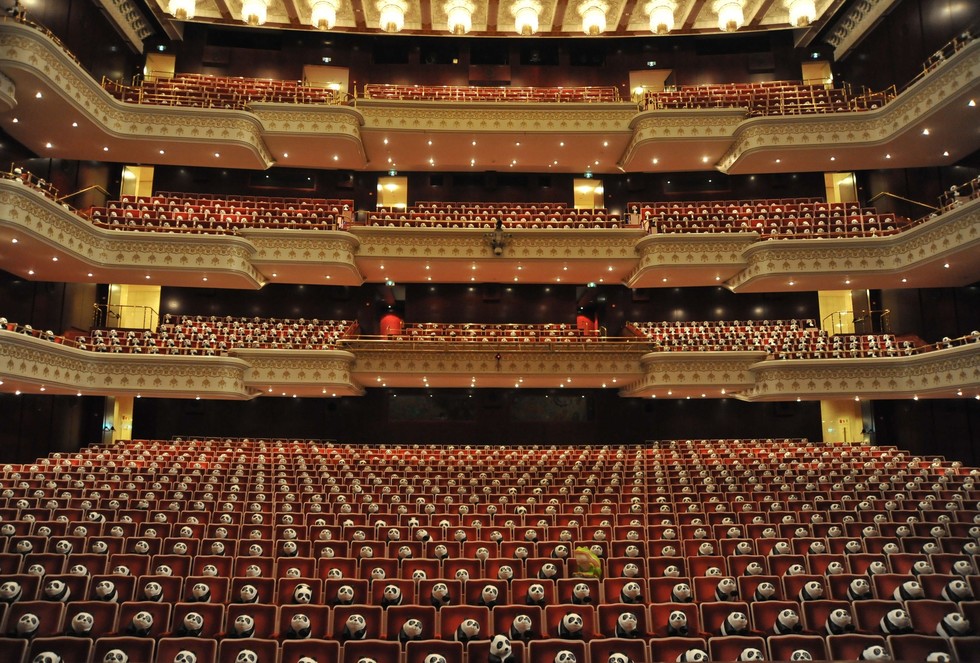
The Pandas on Tour project was launched in 2008 in partnership with the World Wildlife Fund and other organizations as a simple way of showing just how endangered pandas are. The 1600 panda sculptures roughly correspond to the number of pandas that remain in the wild. Over the past 6 years, the pandas have traveled to more than 20 countries, where they’ve provided fabulous photo ops everywhere from the Eiffel Tower to the National Theater in Taipei.

Pandas at Taipei's National Theater
Pandas at Taipei’s National Theater

I mean, look at them in that theater, or on that square. They’re so cute, and there are soooooo many of them! That’s what I feel seriously muddies the intended conservation message of this project. It’s hard to feel like the panda is disappearing when you’re surrounded by an enormous crowd of pandas.

Maybe I’m a grouch, but I can’t help thinking that while the words about this exhibition say “Look how few pandas there are,” the pictures say, “Look how many pandas there are.”

And that seems like a bit of a #PandaFail

panda-slide