Art of Science: Deborah Cornell’s Drifting DNA

Deborah Cornell, Species Boundaries: Wind Map. Digital Print, 2006

Printmaker Deborah Cornell juxtaposes familiar images in unexpected ways to prompt viewers to reflect on big questions in science and culture. Her work explores ideas of reality and change, particularly regarding the interaction of science, technology and nature.

Cornell created a series of prints entitled Species Boundaries that look at the consequences of genetic engineering and the unpredictability of genetic interactions over time. This print, Wind Map, uses the visual echo between a map of wind currents and a micrograph of chromosomes to raise make a point about complex systems and the illusion of control. No matter how hard scientists strive to control their experiments, genetic material is about as respectful of borders as the wind.

Says Cornell, “Nothing exists in isolation – complex interrelationships can produce unexpected results. Questions arise connecting genes to the market economy, altering genetic codes, the migration of altered organisms and their impact on environments, humans and on other species.”

You can see more of Cornell’s work at her website.

Art of Science: Lita Albuquerque’s Magic Pixel Dust


https://vimeo.com/14311444

Lita Albuquerque’s installation Beekeeper (2006), now on view in Santa Fe, is a piece that is much more compelling than the artist’s own description of it would lead you to believe.

According to Albuquerque, “Beekeeper (created in collaboration with Chandler McWilliams and Jon Beasley) is a pair of video projections controlled by generative computer software. The individual pixels that make up the image of the beekeeper separate and move out into space, dissolving the solid form into its constituent parts, spread until the entire wall is covered in a sea of slowly moving pixels, then reverse direction, heading for their original position. The software allows each pixel to choose its own unique path every time, creating a work in a constant state of becoming.” (source)

The artist has said that her goal with this work was “to present the visual similarity between a beekeeper and an astronaut,” which she approached by “[creating] a narrative around which the beekeeper’s aim is to help maintain biological life on the planet and the astronaut became the starkeeper maintaining life in the cosmos.”

On that level, this piece doesn’t work for me. In fact, it makes very little sense. The main visual similarity between apiarists and astronauts is the fact that both wear protective suits. Beekeepers, at least until very recently, were more interested in producing honey than in “maintaining biological life on the planet”, and astronauts are “starkeepers”, protecting the stars and planets from intergalactic threats, only in the movies.

As art that explores how we see and comprehend the world, however, Beekeeper is sublime. Just thinking about how the pixels gather and disperse could keep your mind working for hours. And as a statement about what we human beings are – collections of particles in constant flux – Beekeeper approaches the profound.

You can see Beekeeper in the exhibition Inventory of Light at Peters Projects in Santa Fe until April 25th, and you can find more work by Lita Albuquerque on her website.


Mammoths are Money

David Orr (All Rights Reserved; Used with Permission)

Friends of The Finch & Pea David Orr and Jennie Orr would like your help publishing an illustrated ABCs book for children, Mammoth is Mopey*.

David Orr (All Rights Reserved; Used with Permission)

Mammoth is Mopey brings together a love of language with a love of prehistoric critters. The restrictions imposed by the classic “alphabet book” also provide a rich opportunity for the artist/author to take us on a creative journey. In our house, we collect artistic ABC books, not only as aids to draw our children into developing their language and reading skills, but also for their pure aesthetic beauty.

David Orr (All Rights Reserved; Used with Permission)

Now, the only thing that stands between my kids and Mammoth is Mopey is you. Fortunately, for you, this isn’t one of those “you are in my way and I’m going to go through you” scenarios. This is a, “you need to remember your PayPal password and make an IndieGoGo pledge” scenario. So, get on it, before this does become a “you are in my way” scenario**.

*Do you see what I did there with the post title? Do ya? Do ya? LOOK AT IT! LOOK! AT! IT!

**More accurately, a “you are in the way of my kids’ artistic and linguistic development” scenario, which is a much worse scenario.

Science, Gaudí, Barcelona

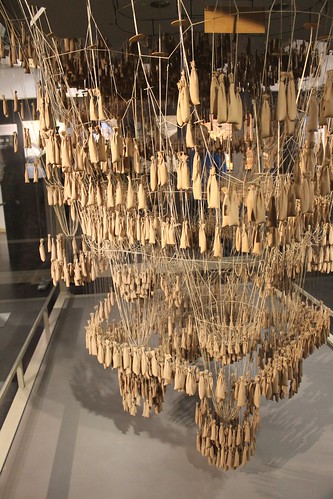
In the basement of the Sagrada Família is a model of a church that Gaudí designed – upside down! The model of the unfinished church at Colonia Güell is made out of strings and little weights. The weights pull the string into the shape of the final building.

Model of Church at Colonia Guell

Gaudí designed the Sagrada Família by similar gravitational principles, although he didn’t build the entire cathedral upside down out of string. The exhibit in the basement shows a bit more of the math and science behind that construction. Continue reading “Science, Gaudí, Barcelona”

Art of Science: Anna Garforth’s Big Bang

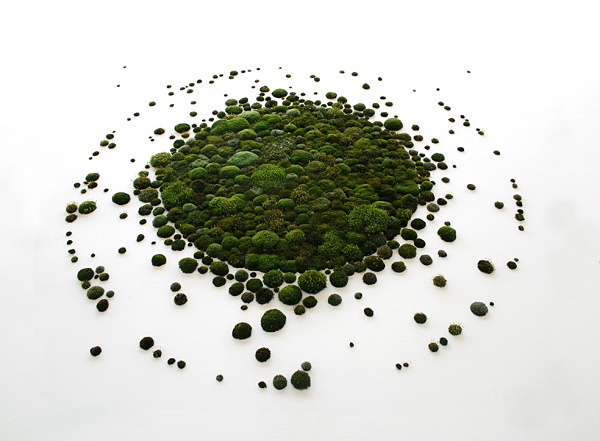
Anna Garforth, The Big Bang, 2012

I like art and I like science. Most of the time, I think that getting the science right makes the art stronger. In this case, well, what the hell? Anna Garforth’s The Big Bang is an installation assembled from hundreds of moss tufts collected from stone walls around Hackney, London. According to Garforth, “the installation depicts Mother Earth as a seed shattering explosion.” So what if plants didn’t show up on our planet until billions of years after the Big Bang? Sometimes, it’s the feeling that counts, and Garforth nails the idea of a sudden eruption that brought forth life on earth.

You can see this piece and lots more of her work on her website.