You can take the yak out of Tibet…

Do yak die at low altitude? When I visited Tibet, I was told that they did, and that the yak you see in zoos are all cross-breeds. Yak genetics have adapted to the high altitude, they said. You can’t take them down, they said.

It sounded plausible, and I thought it was a neat fact to include in a post here. I just needed a reference.

But when I searched, I didn’t find any convincing evidence that yak can’t survive low altitudes. In fact, the more I searched, the less I knew what a yak even was. I found info about wild yaks and domesticated yaks, and some notes about cross-breeds. Among the muddled facts, I found two things that everyone seems to agree on: Bos grunniens is a domesticated yak, and it exists in low altitude zoos far away from Tibet.

Yak
Domestic yak walking out of a Tibetan zoo and nibbling on a plant.

Continue reading “You can take the yak out of Tibet…”

The Eden Project

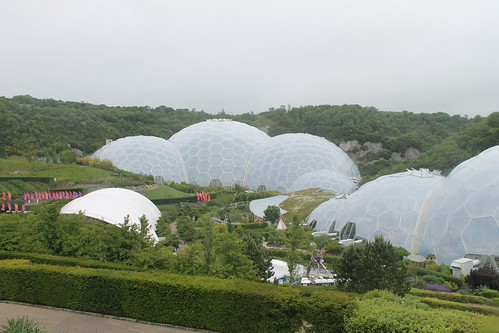
The Finch and Pea at the Eden ProjectLast month I took a four-hour train journey from London to the closest rainforest: the Eden Project in Cornwall. Several people recommended it to me after I described the Biodome in Montreal, and I mentioned it in my blog post about that, as one of the other large biomes in the world.

the Eden Project

The Eden Project consists of three biomes – a 50m high (tropical) rainforest biome, a slightly smaller one with a Mediterranean and Californian climate, and an “outdoor biome”. The latter isn’t in a glass dome, it’s the gardens of the project, and these obviously have a Southern English climate.

I spent most of my visit in the rainforest biome. I was expecting to be hit by a wall of heat, which is what happens when you enter the rainforest area of the Montreal Biodome, but that didn’t happen. It was cool and breezy. I was a bit disappointed. Not because I was looking forward to heat – I don’t do well in anything above room temperature – but because I thought it wasn’t authentic.

I was wrong.

It did get hot in the rainforest biome, just not immediately. After walking further into the forest, the temperature rose to a sticky 32C (about 90F), and that wasn’t on a particularly hot day.

32 degrees C

The warmest spot was the rainforest lookout, a platform at the very top of the dome, from which you had a great view of the rainforest below.
Continue reading “The Eden Project”

Ernie Allison’s “Staycation”

Ernie Allison is a grandfather and nature writer who drags his family on nature hikes and camping trips year round.

Jump Creek Canyon (Photo Credit: Greg Harness, CC BY-NC-SA 2.0)

Vacations are a much anticipated time in most people’s years. That one or two week span where we get to take a temporary break from our daily lives and experience something fun and exciting for a prolonged period of time. For decades my family and I have ventured to the more exotic locations available for our yearly vacations. As a result my wife and I took yearly vacations all over the globe. Just me, her, and exotic locales. What is the point of taking a vacation and sitting at home? That was my father’s perspective and as it became my own. It wasn’t until my later years that I learned the true value of a vacationing at home, aka The Staycation. Continue reading “Ernie Allison’s “Staycation””

Great Barrier Reef

IMG_8468Are there places where science tourists shouldn’t go? Sometimes, visiting a destination also affects that destination. In a forest, it’s easy to minimize the damage: stay on the paths, pick up garbage, don’t scare the animals. But what if the place you want to visit is delicate, and has no paths to stay on – like a coral reef?

The Great Barrier Reef runs along the coast of Queensland and is the largest “superorganism” on earth (It can be seen from space, but, honestly, what can’t be seen from space these days). Even though it’s quite a distance from shore, it’s visited yearly by more than a million tourists and brings in several billion dollars each year. Continue reading “Great Barrier Reef”

Wellcome Collection

C0017129 Medicine Man Exhibition displaysThe Wellcome Collection bills itself as a “destination for the incurably curious”, and indeed, the last time I was there I spent a good few minutes opening the drawers of a large cabinet, one by one, to reveal strange old medical prints inside.

Henry Wellcome founded Burroughs Wellcome & Company in the late 19th century. The company later merged into what is now Glaxo Smith-Kline. When he died, he left his share of the company to trustees, to spend on health projects. The Wellcome Trust is currently one of the main funders of biomedical research in the UK.

The Wellcome Collection, however, is the result of Wellcome’s hobby, not of his work. Henry Wellcome collected medical artefacts from all over the world. Continue reading “Wellcome Collection”