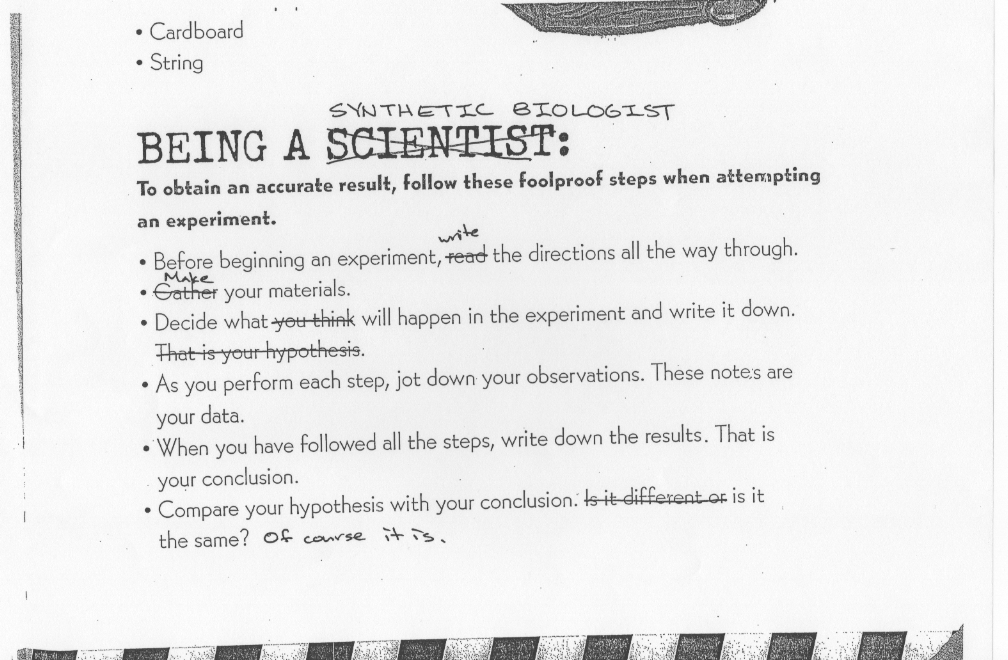
Being a Scientist: Synthetic Biologist

Honestly, I’m not sure I know what a “synthetic biologist” is. I think the term is something that the people doing it make up as they go along – like their organisms.

You can get your own “Being a Scientist” template here and create your own, you crafty bastards you.

Nature on science’s perverse financial incentives

Paula Stephan, an econ professor at Georgia State and an NBER research associate has a comment in this week’sNature on perverse financial incentives in science. This includes the perverse incentives that govern the role of postdocs in research:

Consider the financial calculations that encourage universities to hire a series of postdocs rather than staff scientists. Postdocs earn around half to two-thirds of a staff scientist’s salary. They are young, have fresh perspectives and new ideas and are temporary, so can be let go when budgets decline2. But, in reality, postdocs are not cheap: substantial resources — both their own and society’s — have been invested in training them.

If a postdoc doesn’t get a research job, taxpayers do not get a return on their investment. Neither does the postdoc: someone who did not go to graduate school and entered the labour market in 2001 was earning about US$58,000 in 2008; a first-year postdoc who started graduate school in the United States in 2001 was making around $37,000 in 2008 on graduation3. During a three-year postdoc position, a scientist gives up more than $60,000 on average in return for highly uncertain job prospects. And many postdocs will not get a research job. There are few faculty openings, and limited numbers of research positions in government and industry. So even if individual postdocs cost less, from a societal perspective they can be expensive.

And here’s a suggestion many people won’t like, but it would certainly reorganize the financial incentives:

In addition, we should consider ways of making graduate students and postdocs more costly to universities, to discourage their overuse and reflect their social cost.

Best Sci-Fi of the 1950’s

Joachim Boaz has his excellent picks for the best 11 science fiction books of the 1960’s, and he’s looking for more opinions on favorite 60’s sci-fi.

Since I’ve spent the last six months focused almost exclusively on 50’s sci-fi, I’m not prepared to say much about the 60’s (but stay tuned). So here I present my picks for the best 11+ sci-fi novels of the 1950’s, with the caveat that I think most of the very best sci-fi of this decade came in the form of short stories, by Heinlein, C.M. Kornbluth, Robert Sheckley, Theodore Sturgeon, and a bunch of others. This means that when you’re browsing your favorite used book store for vintage sci-fi, don’t neglect the anthology section.

In chronological order: Continue reading “Best Sci-Fi of the 1950’s”

Social scientists argue that social scientists shouldn’t do science

Sean at Cosmic Variance is rightly upset over an op-ed by University of Rochester political scientists, who write:

Many social scientists contend that science has a method, and if you want to be scientific, you should adopt it. The method requires you to devise a theoretical model, deduce a testable hypothesis from the model and then test the hypothesis against the world…

But we believe that this way of thinking is badly mistaken and detrimental to social research. For the sake of everyone who stands to gain from a better knowledge of politics, economics and society, the social sciences need to overcome their inferiority complex, reject hypothetico-deductivism and embrace the fact that they are mature disciplines with no need to emulate other sciences…

This isn’t a matter of emulating other sciences – it’s a matter of actually doing science, any science. Science’s commitment to empirical support and hypothesis testing is why it works so damn well. And it is the track record of success that is the source of science’s cultural authority – not the fancy degrees, scientists’ IQs, or deep thoughts. People outside science also have fancy degrees, high IQs, and deep thoughts. What sets science apart is its devotion to testing hypotheses and revising your beliefs in response to the results.

Jerry Coyne reads Stanley Fish so we don’t have to

Why Evolution Is True: “Stanley Fish misunderstands science; makes it a faith equivalent to religion

Fish’s big mistake: the reasons undergirding that belief are not that we can engage in a lot of philosophical pilpul to justify using reason and evidence to find out stuff about the universe. Rather, the reasons are that it works: we actually can understand the universe using reason and evidence, and we know that because that method has helped us build computers and airplanes, go to the moon, cure diseases, improve crops, and so on. All of us agree on these results. We simply don’t need a philosophical justification, and I scorn philosophers who equate religion and science because we don’t produce one.

Continue reading “Jerry Coyne reads Stanley Fish so we don’t have to”