

When I was young, I used to build elaborate castles out of wooden blocks. Then, my younger brother Ben, would come running through and smash it all to pieces. Ben was a metaphor for the way my high school history book1 presented a variety of groups like the Mongols, the Huns, the Vikings, and the Sea Peoples (oddly not the Conquistadors, etc.) as nightmarish, irresistible, and bent on wanton destruction. Like my brother, they were external forces of chaos that swept in, pushed “Western Civilization” to the breaking point, and then mysteriously vanished. Of these groups, the Sea Peoples distance in the past made them, by far, the most mysterious.
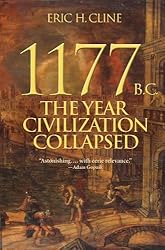 In Eric H. Cline’s 1177BC: The Year Civilization Collapsed2 does not set out to clarify the record on the Sea Peoples – they remain pretty clouded in the mists of time. Rather, Cline walks us through what historians know, suspect, and argue about. Cline’s goal is to help us understand what collapsed at the end of the Bronze Age, what “collapse” actually meant, why it was so important, and what were the factors that caused this change. Continue reading “Eric H. Cline’s “1177BC”: Bronze Age Bogeymen & the Fate of Civilization”
 Not all post-apocalyptic fiction is about death. That might seem odd, given the high death toll in this genre. But most of it is about something else, like nature, war, technology, civilization, or even
 The Finch and Pea