Count Like An Egyptian: More fun than you think!

Greg Gbur is an associate professor of physics, specializing in optical science, at UNC Charlotte.

IMG_5647

I’ve been a fan of ancient Egyptian history and culture since I was a kid. My Dad would take me to the Field Museum in Chicago and we would browse the beautiful Egyptian art and artifacts.  When King Tutankhamun’s treasures reached the Field Museum in 1977, I was there to see them, standing in lines that rivaled those of Star Wars, which opened earlier that same year.

One aspect of ancient Egyptian culture that I failed to pay much attention to, however, is mathematics.  Conventional wisdom for years has suggested that, although ancient Egypt had a functioning mathematics system, it was rudimentary and flawed in many ways. I assumed that this was the case without k10197looking too much into it – besides, what sort of insight could one gain from learning an antiquated system of mathematics?
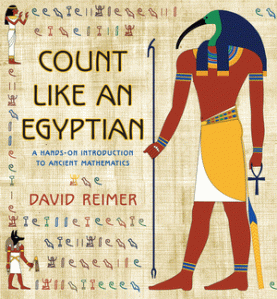
Now a book has come out that aims to correct these flawed opinions of ancient mathematics: Count Like an Egyptian by David Reimer, an associate professor of mathematics at the College of New Jersey. Continue reading “Count Like An Egyptian: More fun than you think!”

It’ll take more than tweaking NIH review to promote young scientists

The NY Times ran an op-ed by a Maryland Congressional representative arguing that younger biomedical investigators, who are at what should be the most creative time of their careers, are getting screwed in the current funding climate. He suggests that Congress should force the NIH to change this:

Congress should also mandate that the median age of first research awards to new investigators be under 40 within five years, and under 38 within 10 years. Failure to meet these benchmarks would result in penalties for the N.I.H., including possible funding cuts.

But people aren’t just getting funded later – it looks like they’re getting their first tenure-track jobs later as well. There are probably proportionally fewer younger investigators that the NIH could fund. The average age at which people get their first assistant professorships at U.S. medical schools appears to have climbed steadily, closely tracking the rise in age of investigators getting their first R01s. (There are some conflicting data; my guess is that it’s important to distinguish between first tenure-track job at any institution (NSF survey), and first tenure-track job at medical schools (AAMC data), where most people who apply for R01’s work.) This shouldn’t be surprising – competition for faculty jobs is growing, and as the economist Paula Stephan has argued, there is some evidence that those who go on to tenure track jobs do longer postdocs than those who don’t. This isn’t a problem that will be solved by forcing the NIH to fund more younger investigators.

Science for the People: High Price

sftp

This week, Science for the People is looking at the science and policy of treating drug addiction. They’re joined by psychology professor and researcher Carl Hart to talk about his book “High Price: A Neuroscientist’s Journey of Self-Discovery That Challenges Everything You Know About Drugs and Society.” And they’ll speak to Donald MacPherson, Director of the Canadian Drug Policy Coalition, about harm reduction strategies to reduce the negative consequences of drug use.

*Josh provides research help to Science for the People and is, therefore, a completely biased and cooperative member of the team.

The Science of Weezer

On the 537th episode of the WTF with Marc Maron Podcast, Marc Maron has an interesting conversation with Rivers Cuomo* of Weezer about his method for songwriting, particularly in the gap between Pinkerton (1996) and The Green Album (2001).

What I find so captivating is Cuomo’s application of a scientific mindset to “solving” his creative process  in the hopes of working more efficiently and effectively. He fails, but does not conclude that his art cannot be understood by science. His problem was a classic scientific problem of too many variables, too small of a sample size (ie, n=1), and too little time. Cuomo also defies Maron’s efforts to portray his analytical quest as potentially maddening. It simply wasn’t productive enough.

I’m going to recommend the whole interview, but the segment I have described starts at about the 34:50 mark.

*Promoting Weezer’s new album Everything Will Be Alright in the End.

Pinker explains why academics can’t write

Ahead of tomorrow’s release of Steven Pinker’s new book on writing, The Chronicle features a teaser essay – “Why Academics’ Writing Stinks”:

An insight from literary analysis and an insight from cognitive science go a long way toward explaining why people who devote their lives to the world of ideas are so inept at conveying them.

Bad academic writing shouldn’t be so surprising. During your training as an academic, you get almost no training in writing after your undergrad studies. Sure, you are required write, but you’re not formally trained to do it well. In fact grad students in the sciences generally don’t write very much anyway – a thesis proposal, and a couple of papers, so maybe 4-5 relatively short manuscripts during your entire 5-7 years of PhD training.

I won’t make any grand claims for my own writing, but I have to plug my favorite style guide: Joseph Williams’ Style beats Strunk & White, hands down.

UPDATE: Link fixed!!!