I don’t like getting drawn into partisan fights when it comes to science, because federally funded research has generally had broad bipartisan support in Congress for more than a half-century. But there is no point in denying that the funding bill that just passed the House is a blatantly partisan effort by GOP leaders to impose their political ideologies — which include climate change skepticism — on our research agenda.
As I discuss in my recent Pacific Standard column, curiosity, and not partisanship should drive our scientific agenda when it comes to basic research. That’s generally been the rule at our basic science agencies, and the current leadership of the House of Representatives doesn’t like it.
This week, the House passed a highly partisan funding bill that would dramatically and disastrously reshape our science agencies along the lines of GOP preferences. Among the mischief attempted by these lawmakers is an push to slash funding for earth sciences at NASA and the NSF, in a poorly disguised effort to dial back climate change research. Representative Bill Foster (D-IL), a physicist, put it best: this bill reflects “the majority’s efforts to impose their own personal beliefs and ideologies on the process of scientific discovery.”
Fortunately, the White House has issued a veto threat. And its Office of Science and Technology Policy is pushing back against the GOP leadership’s misleading claims that they’re just trying to get the NSF and NASA to focus on “core science” or research that’s “in the national interest.” The OSTP has started a Twitter campaign under the hashtag #BasicResearch: Continue reading “Standing Up For Basic Research”
As Eva described at Science Studio, it turns out that The Offspring’s Dexter Holland has gone back to working on his PhD in molecular biology after taking some time off to be a rockstar. His thesis is looking at the use of microRNAs by HIV during infections. Holland now as the unofficially required first author paper (PDF link; authored as Bryan Holland) needed to be allowed to defend.
Not only is the name “The Offspring” probably inspired by biology, but the famous lyric “keep ’em separated” was inspired by an experience Holland had pouring plates in graduate school, which you can hear Dexter describe in an interview about his music and science on The Nerdist Podcast.
Long ago, in a kingdom that no longer exists, a bohemian traveller was mistaken for a fugitive revolutionary, and arrested.
Borodin (left) and Mendeleev (right)
The traveller was Russian chemist and composer Alexander Borodin. He was on his way to Italy with his friend Dmitri Mendeleev. Both men were researchers in the chemistry department of the University of Heidelberg, where they learned the ropes from Robert Bunsen (inventor of the bunsen burner) and Emil Erlenmeyer (inventor of the erlenmeyer flask). In a few years, Mendeleev would develop his own classic staple of chemistry labs – the periodic table – but now he was taking a break from science, and making his way to Italy with his friend.
They travelled light, and brought very little clothes with them. “We wore only blouses, so that we would look like artists”, Mendeleev has said of this trip. “That’s not a bad idea in Italy, because you can get along very cheaply that way. We took hardly any shirts with us, and had to buy new ones when the need arose; we gave these away to the waiters in place of tips. We absolutely let ourselves go in Italy, after the stifling cloistered life of Heidelberg.”
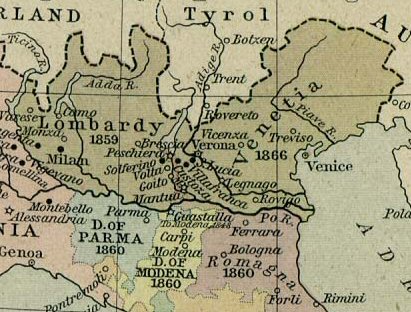
Picture these two men, dressed in their artists blouses, walking across large parts of Switzerland. Looking nothing like the academics they were in Heidelberg, they reached the Kingdom of Lombardy-Venetia. This kingdom no longer exists. The area is now Northern Italy, but was then part of the Austrian Empire, and Austrian police were on the lookout for a political fugitive.
Seeing a bohemian figure who matched the description of the revolutionary they were told would cross the border that day, the police arrested Borodin.
He was not at all the man they were looking for. Borodin had led a quiet and privileged life, filled with books, music, and education. After graduating from medical school in St Petersburg, he moved to Heidelberg to study chemistry. He spent all of his free time making music, and had already composed several pieces for piano, voice, or string ensembles. Much later, years after his untimely death at a costume party, Borodin would posthumously win a Tony Award for composing the original score used in the musical Kismet. He was a chemist, a musician, a Russian prince’s illegitimate son, a women’s rights activist, and an educator – but not a member of an Italian revolutionary movement.
By the time the police realised their mistake, the real fugitive had taken advantage of the distraction, and crossed the border. When Borodin and Mendeleev finally boarded their train, they were greeted with cheers and applause by the Italian passengers, for unwittingly helping a member of the revolution escape.
We don’t know the identity of the mysterious fugitive, but at the end of the Austro-Prussian War in 1866, the Kingdom of Lombardy-Venetia was no more. The region became part of Italy, which it still is. And somewhere along the way, two Russian chemists on a low budget holiday may have played a very minor role in shaping the political situation in 19th century Northern Italy.
Source: the book “Borodin”, by Serge Dianin, translated by Robert Lord (1963). Mendeleev’s words about their outfits are quoted in the book, but originally from another book by M.N. Mladentsev and V.E. Tischenko, called “Dmitry Ivanovich Mendeleev. His Life and Work, Vol I.” (1938). The photo of Borodin and Mendeleev is a crop from a larger photo including two other chemists – Gitinsky and Olevinsky. The original photo was taken in 1860 – the year this story takes place. Lombardy-Venetia map in the public domain, via Wikimedia.





 The Finch and Pea
