
Useless

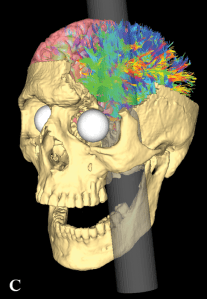
Twitter was grumbling this morning about a paper in PLoS ONE titled, “Mapping connectivity damage in the case of Phineas Gage”. Phineas Gage is the legendary railroad worker that had a tamping spike driven through his skull and survived. The authors used a computer to model the damage done by the tamping spike, estimate how that would have disrupted Gage’s neural networks, and look for correlations with his reported behavioral changes.

Sounds gimmicky. Nerds don’t like gimmicks. Words like “useless” and “waste of time” were bandied about. Why study a dead guy instead of living people with brain injuries that you might help?

I am not equipped to pass judgment on the results of this study. I do, however, have experience with the issues raised by experiments that may require human subjects. This study may be fatally flawed, but it was not wasting resources and Phineas Gage was more than a gimmick. Continue reading “Useless”
The Walking Dead’s Bloody Mess 2

*SPOILER ALERT*

Previously on The Walking Dead’s Bloody Mess. . .

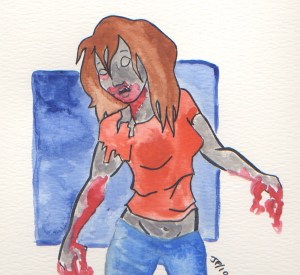
. . .we discussed how incredibly unlikely it would be that Rick would be the only available blood donor for Carl among the group of survivors on Hershel’s farm1. This led us2 to wonder what the blood type of his mother, Lori Grimes, might be. It is not at all unusual for a parent to not be a compatible donor for their child, especially for a direct transfusion. Lori is pregnant and her blood type could be important to the health of the wee baby Grimes (WBG). Continue reading “The Walking Dead’s Bloody Mess 2”

CSHL Biology of Genomes Wrap-Up

After five grueling but interesting days, the Cold Spring Harbor Labs Biology of Genomes has wrapped up. So where is genomics heading?

A few lessons: Continue reading “CSHL Biology of Genomes Wrap-Up”

“The Power of Habit” Colored Glasses

When I first went over to the table of review copies at Science Online 2012 and saw Charles Duhigg’s The Power of Habit: Why We Do What We Do1 and How to Change It, I thought “Why would I want to read a self-help book?”2

Fortunately, The Power of Habit is not a self-help book, in that it is both informative and helpful. Duhigg invites the reader to view human behavior through the lens of habits through a seamless blend of compelling personal stories and scientific research. Duhigg convincingly argues that these principles worked for the people in the anecdotes and will work for you.

Viewing the world through the lens of habits added depth and understanding to an already moving experience I had earlier this year. In January, my wife and I visited a chemistry class at Hamilton Township High School in Hamilton, OH3 to talk about science and careers in science with the students4. Continue reading ““The Power of Habit” Colored Glasses”

Energy and information (or lack thereof) in biological thinking

Eric Smith, “Thermodynamics of Natural Selection” (PDF):

The two paradigms dominating biological theory are the machine-like functioning of componentry (increasingly elaborated in molecular biology) (Alberts, 2002), and the Darwinian framework for understanding the stochastic dynamics of death and reproduction (Gould, 2002; Lewontin, 1974). The representation of biological processes as machines is often by way of models, which represent control flow and causation, and for which the goal is to conceptually or quantitatively reproduce typical observed behaviors (mechanisms of binding, Stormo and Fields, 1998, transcription or translation, Berman et al., 2006, cell cycling, Novak et al., 2001, regulation of cell division, Tyson et al., 2002 or metabolic pathways, Holter et al., 2001, etc.). Energy naturally appears in these contexts as an input, as a quantitative constraint, or as a medium of control. However, models constructed for the purpose of illustrating causality often diminish the importance of the incursion of error at all levels of organization and the consequent energetic costs of systemic error correction, and so are not suited to composition into a system-level description of either emergence or stability. At the other extreme, Darwinian selection is a purely informational theory, concerned with emergence and stabilization through statistical processes. Yet, for lack of a comprehensive theory of individual function, models of the dynamics resulting from selection inevitably take for granted (Hartl and Clark, 1997) the platform of physiology, growth, development, and reproduction, decoupling the problem of information input from energetic constraints on the mechanisms by which it occurs.