
Lake Vostok Bacteria & the Power of Social Media

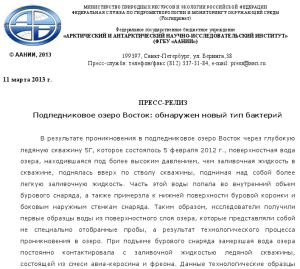
Click here for full press release (PDF)

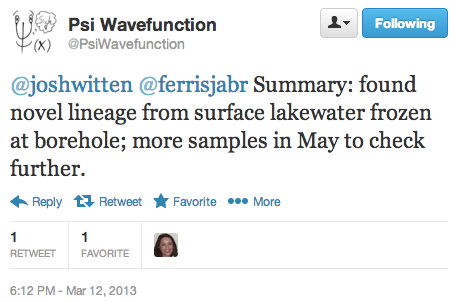
Today, I had to explain to my 4-year-old that Daddy was a little later than usual (I was not “late”) picking her up from school because he was helping facilitate and curate a live tweeted translation/paraphrasing of a press release in Russian (by @PsiWavefunction) about the odd bacteria that may or may not have been discovered by a research program to drill into and investigate a gigantic sub-glacial lake that has been sealed off from the rest of the world for millions of years.

You can follow the translation by PsiWavefunction on the Storify I created as we went. The take home message from the press release was Russian scientists are not incompetent doofuses and:
My daughter’s response? “Antarctica is where penguins and King Cryolophosaurus live!”
Cutting the second slide & Dollo’s “Law”

A recent study on house dust mites has shown that the mighty mites have evolved “in reverse” from an obligate parasite into a free living organism. That is pretty cool. Yet, I find myself in the position once again of questioning the way the research is presented without questioning the quality of the research itself.

For permanent parasites and other symbionts, the most intriguing question is whether these organisms can return to a free-living lifestyle and, thus, escape an evolutionary “dead end.” This question is directly related to Dollo’s law, which stipulates that a complex trait (such as being free living vs. parasitic) cannot re-evolve again in the same form. Here, we present conclusive evidence that house dust mites, a group of medically important free-living organisms, evolved from permanent parasites of warm-blooded vertebrates. – Klimov & O’Connor 2013

The researchers present their result as a refutation of Dollo’s Law, which postulates that evolution is irreversible: Continue reading “Cutting the second slide & Dollo’s “Law””

Right Answer, Wrong Question

Author’s Note: Post was written without access only to the abstract, not the full text, of the journal article in question. Note that the argument is not with the methods or results of the research, but with how the research question has been presented.

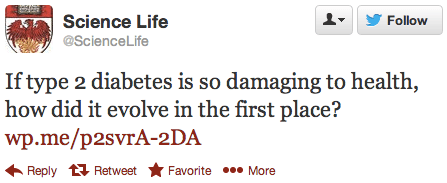
University of Chicago Medicine & Biological Sciences tweeted the following tweet on Twitter today highlighting the work of post-doc Laure Ségurel on genetic risks for Type 2 Diabetes:
Screen Shot 2013-03-08 at 8.33.27 AM
The work itself is interesting in its own right. Investigating the population genetic history of genetic markers associated with Type 2 Diabetes risk could have multiple applications, beyond the high level of intellectual interest.

The question used to frame the research, however, troubles me, because it plays to general misconceptions about the evolutionary dominance and efficiency of natural selection in humans:

Why is this deleterious disease so common, while the associated genetic variants should be removed by natural selection? –Ségurel et al (Eur J Hum Genet. 2013 Jan 23. doi: 10.1038/ejhg.2012.295)

Continue reading “Right Answer, Wrong Question”

Meet the Springtail

Orchesella cincta (Photo by Mvuijlst - Creative Commons Attribution-Share Alike 3.0 Unported)
Orchesella cincta (Photo by Mvuijlst – Creative Commons Attribution-Share Alike 3.0 Unported)

Springtails are all around us.

Springtails (Collembola) are hexapods but not insects, being members of the insects’ sister class Entognatha (which also includes proturans and diplurans). They are tiny (<6mm), and numerous, occurring at densities up to around 100,000 per square meter of topsoil. They are important components of forest floor ecosystems, and some species can also be found floating on the surface of stagnant water. Continue reading “Meet the Springtail”

The Unfeathered Bird – A review in three parts

Skulls of Galapagos Finches by Katrina von Grouw - The Unfeathered Bird (2012 Princeton University Press - Used with Permission)
Skulls of Galapagos Finches by Katrina von Grouw – The Unfeathered Bird (2012 Princeton University Press – Used with Permission)

Katrina van Grouw‘s The Unfeathered Bird is a complicated book that combines elegant writing, copious information, and beautiful illustrations with bird anatomy. There may only be one person on earth prepared to handle all of that on her own. She wrote the book. And, it took her over 25 years.

We don’t have anyone that can cope with The Unfeathered Bird on their own. That’s ok. A multifaceted book should get a multifaceted review. So, we created a dream team of reviewers: artist Michele Banks focused on the artistry, Rebecca Heiss (PhD in avian physiology) focused on the avian physiology information, and Josh, me, focused. . .well it is not entirely clear what I focused on, like usual.

Michele Banks: The Art of The Unfeathered Bird
Rebecca Heiss: The Birds of The Unfeathered Bird
Josh Witten: The Layers of The Unfeathered Bird