Superb Science Times

I don’t know what the special occasion is, but today’s NY Times Science section has a star-studded lineup:

Natalie Angier, Nicolas Wade, Carl Zimmer, and Sean Carroll all have fascinating pieces up in today’s Times.

The topic:

This issue of Science Times is devoted to our many bonds with animals, and also to the distance between us and them. No other animal makes operas or nuclear weapons. How did we become so different? What made us human?

One more reason to fear global warming

Heat Damages Colombia Coffee, Raising Prices:

In the last few years, coffee yields have plummeted here and in many of Latin America’s other premier coffee regions as a result of rising temperatures and more intense and unpredictable rains, phenomena that many scientists link partly to global warming…

In 2006, Colombia produced more than 12 million 132-pound bags of coffee, and set a goal of 17 million for 2014. Last year the yield was nine million bags…

Yet as stockpiles of some of the best coffee beans shrink, global demand is soaring as the rising middle classes of emerging economies like Brazil, India and China develop the coffee habit.

Nonexistent due process on the internets

From Ars Technica: A Silicon Valley Democrat Representative looking for GOP help:

At 9:30pm PST on February 11, US Immigrations and Customs Enforcement (ICE) seized the domain mooo.com. They ordered the domain name’s registrar to redirect all traffic headed for mooo.com to a government IP address, one which displayed a single stark warning that the domain name had been seized for involvement with child pornography.

But the mooo.com domain name was shared between 84,000 sites; every one suddenly displayed the child pornography warning. The mistake was soon corrected, but the free domain name provider running mooo.com warned users that removal of the banner from their sites might “take as long as 3 days.”…

Rep. Zoe Lofgren (D-CA), who holds a law degree, is furious about the mistake. At a recent Congressional hearing, Lofgren grilled IP Czar Victoria Espinel about the incident and stood up for the 84,000 affected sites. “If I were them, I’d sue the department,” she thundered.

The article goes on to indicate that Rep. Lofgren is looking for GOP support to block a disappointing Democratic leadership-endorsed bill that would run roughshod over due process when it comes to internet seizures. If the GOP actually cared about due process for people without deep corporate pockets, Rep. Lofgren might have a chance. Her best hope is that the GOP blocks this simply because they hate Dems.

More importantly, this is just yet one more reminder that, as a society, we haven’t yet figured out how previously cherished ideals of due process, free speech, privacy, etc. apply to the rapidly evolving technological thicket of the internet.

Export regulations for my Dell monitor

Apparently, it is illegal to sell my Dell monitor to, say, a relative or friend who works for Lat Alamos, Oak Ridge, or similar facility. From the product information guide:

Export Regulations… In addition, the Products may not be sold, leased, or otherwise transferred to, or utilized by an end-user engaged in activities related to weapons of mass destruction, including without limitation, activities related to the design, develpment, productions, or use of nuclear weapons, materials, or facilities…

Education makes you dumber…

At least in this case:

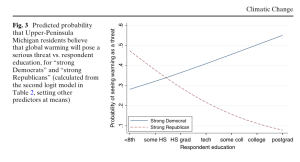
From “Education, politics and opinions about climate change evidence for interaction effects” (PDF):

Abstract U.S. public opinion regarding climate change has become increasingly polarized in recent years, as partisan think tanks and others worked to recast an originally scientific topic into a political wedge issue. Nominally “scientific” arguments against taking anthropogenic climate change seriously have been publicized to reach informed but ideologically receptive audiences. Reflecting the success of such arguments, polls have noted that concern about climate change increased with edu- cation among Democrats, but decreased with education among Republicans. These observations lead to the hypothesis that there exist interaction (non-additive) effects between education or knowledge and political orientation, net of other background factors, in predicting public concern about climate change. Two regional telephone surveys, conducted in New Hampshire (n=541) and Michigan (n=1,008) in 2008, included identical climate-change questions that provide opportunities to test this hypothesis. Multivariate analysis of both surveys finds significant interactions. These empirical results fit with theoretical interpretations and several other recent studies. They suggest that the classically identified social bases of concern about the environment in general, and climate in particular, have shifted in recent years. Narrowcast media, including the many Web sites devoted to discrediting climate- change concerns, provide ideal conduits for channeling contrarian arguments to an audience predisposed to believe and electronically spread them further. Active- response Web sites by climate scientists could prove critical to counterbalancing contrarian arguments.

There seems to be something here that explains a lot about beliefs other than climate change: evolution and political subjects like health care and economic policy – pretty much any subject where an intellectually indefensible position is in fact defended by ideologically-driven snake oil outfits whose product is scientific-sounding doubt of some mainstream scientific consensus. See “The Merchants of Doubt”.

UPDATE: Here is some follow-up material on this issue, some of which shows that on the subject of evolution, there is still an enormous conservative/ liberal split (with reality favoring the liberals again), but education doesn’t make you dumber.