Hunger Games and Teenage Angst in the New Yorker

I read this one when it came out back in 2010, but The New Yorker is highlighting it today to capitalize on the Hunger Games movie release:

“Fresh Hell”, Laura Miller:

…dystopian stories for adults and children have essentially the same purpose—to warn us about the dangers of some current trend. That’s certainly true of books like “1984” and “Brave New World”; they detail the consequences of political authoritarianism and feckless hedonism. This is what will happen if we don’t turn back now, they scold, and scolding makes sense when your readers have a shot at getting their hands on the wheel. Continue reading “Hunger Games and Teenage Angst in the New Yorker”

Science career pessimism: it’s not just me

Before actually becoming a scientist, I had a particular view of what a science career was about. Part of this view came from reading biographies of famous scientists, but a big part came from being the child of scientist who is not famous but very successful. My experiences in grad school and during my postdoc have been a great disillusionment, despite the marvelous intellectual experiences and the caring and inspiring mentors it’s been my privilege to work with. You’re probably thinking, well duh, anyone in any career hits a point of disillusionment because nothing is every as glamorous as it seems from the outside, except perhaps the life of a billionaire hedge fund manager. (If you make more than $100 million annually, I don’t want to hear any shit about your life not being as glamorous as it seems… it’s plenty glamorous.)

Back to science careers – as I’ve discussed before, there is some external evidence that my impressions aren’t simply the natural impatience of someone near the end of the long so-called training period. Here’s one more report on the issue, this time from way back in 2001, when the NIH budget was still on a path to doubling and long before R01 grant success rates hit an all-time low in 2011:

“Careers and Rewards in Bio Sciences: the disconnect between scientific progress and career progression” (PDF): Continue reading “Science career pessimism: it’s not just me”

Graphic History of the Dystopian Novel

Goodreads blog has a nice graphic timeline of the dystopian novel. The genre appears to have peaked in the mid-40’s, the mid-50’s, and well, now. The difference between now and the 50’s, according to the graphic, is that today’s swath of dystopian books aimed at teenagers features more romance, is inspired by the “vapidity of pop culture”, and is rated more highly by women than by men. That’s probably because zombie apocalypses are notably missing from the timeline.

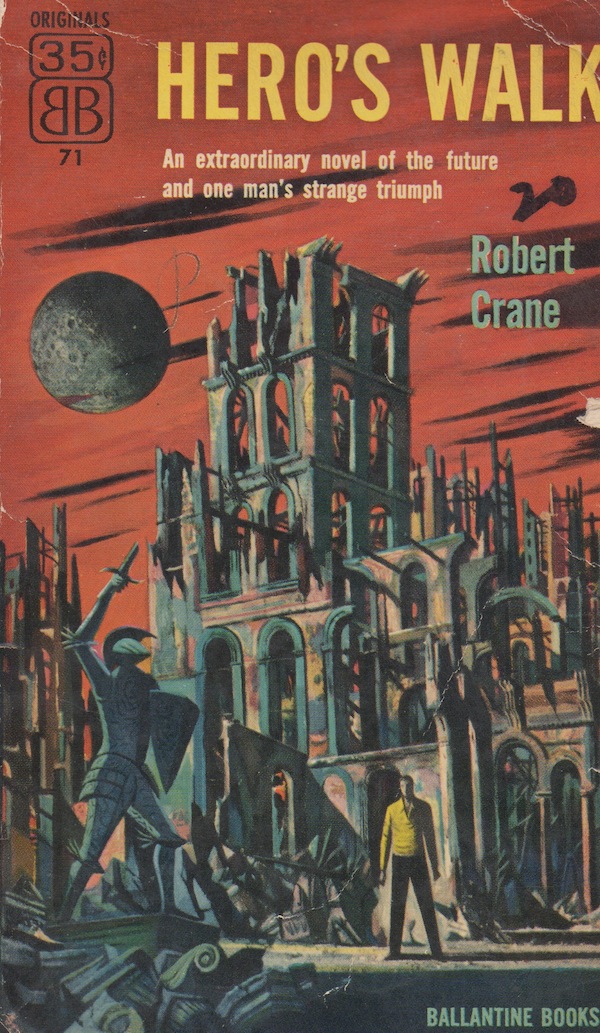
Apocalypse 1954: Hero’s Walk

Cold War Geopolitics in Space

Hero’s Walk, Robert Crane, 1954

Humanity has united under a world government called InterCos, and has set out to boldly colonize the rest of the solar system. But strange, disturbing radio transmissions from space may be an alien warning against humanity’s imperialist ambitions. The politicians wrangle over the meaning of the transmissions, and use the issue to do what politicians always do – further their own power. Disregarding the frantic warnings of a desperate scientist who sees the alien threat, InterCos moves ahead with colonization, until the alien bombs start to fall. Hero’s Walk is basically a Cold War parable, published in the same year as the famous Oppenheimer security hearing, a critique of the reckless brinkmanship of the political leaders that threatened the world with the nuclear annihilation that scientists like Oppenheimer were warning about. Continue reading “Apocalypse 1954: Hero’s Walk”

Throwing in the towel

How I often feel about my science career in a nutshell (and I’m not the guy with the beret) – from xkcd:

DNA is easier to read than the workings of success.