
Sunday Poem

Not much science in this week’s Sunday poem, but since Monday is the U.S. Memorial Day, and since Walt Whitman’s birthday is May 31st, I think an appropriate selection is the following passage, one of the most sublime sentences in all American poetry, from Walt Whitman’s memorial poem, “When Lilac’s Last in the Dooryard Bloom’d.” Memorial Day began as Decoration Day, originally designated to honor the U.S. Civil War Dead. In this passage, Whitman breaks a sprig of lilac as a memorial offer to the assassinated Abraham Lincoln and all of those fallen in the Civil War.

In the door-yard fronting an old farm-house, near the white-wash’d palings,
Stands the lilac bush, tall-growing, with heart-shaped leaves of rich green,
With many a pointed blossom, rising, delicate, with the perfume strong I love,
With every leaf a miracle – and from this bush in the door-yard,
With delicate-color’d blossoms, and heart-shaped leaves of rich green,
A sprig, with its flower, I break.

If you’re not familiar with this great poem, go read the entire thing here. And if you are familiar with the poem, go read it again.
Don’t make biology boring

This was my experience – “Learning Biology by Recreating and Extending Mathematical Models”:

Although biological systems generate beautiful patterns that unfold in space and time, most students are taught biology as static lists of names. Names of species, anatomical structures, cellular structures, and molecules dominate, and sometimes overwhelm, the curriculum and the student. Cookbook labs may demonstrate advanced techniques but have a foregone conclusion. Not surprisingly, students often conclude that biology is boring.

Continue reading “Don’t make biology boring”

Saving lost SF classics

What a great idea:

We love books. A lot. And we love sci-fi books, new and old. But mostly old.

And there are a lot of great old sci-fi books out there that are out of print, out of circulation, and, worst of all, not available in any sort of digital format.

Given the subject material, that’s just not right. Continue reading “Saving lost SF classics”

The Sensual Science Fiction of C.L. Moore

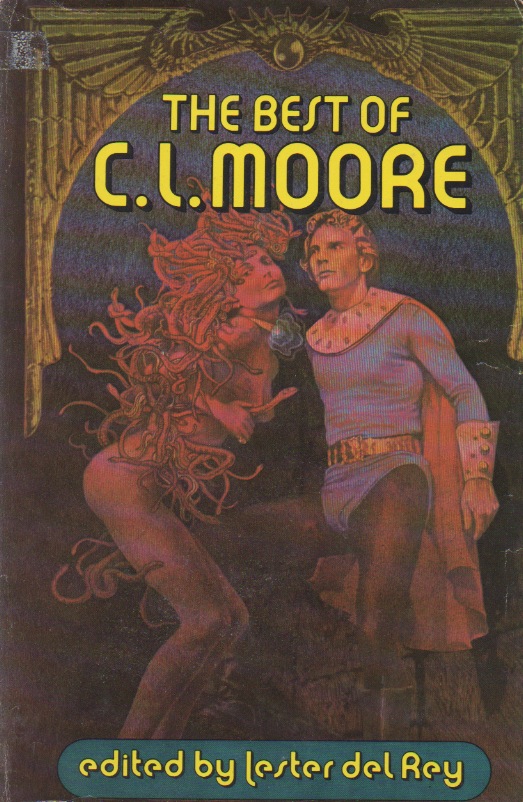
My luckiest find at my local library’s discarded book sale bears one of the most embarrassing science fiction covers I’ve ever seen – a remarkably high bar to reach. This cover features a blond hero in a failed Halloween costume that includes tights, cape, and blue leotard, staring past a naked medusa who is attempting, without much success, to strike an erotic pose while fondling a very phallic snake. For a mere quarter, I picked up this ridiculous piece of art, but along with it I scored some of the very finest stories ever to come out of the Golden Age pulp magazines of the 1930’s and 40’s: The Best of C.L. Moore. In a genre featuring techno-fantasies of omnipotent super-scientists rationally masterminding the world, to the delight of fawning female props, Catherine L. Moore managed to thrill fans with sensuous, complex, character-focused stories about desire, love, and women. The Best of C.L. Moore features ten stories that are essential reading for any fan of Golden Age science fiction. Continue reading “The Sensual Science Fiction of C.L. Moore”

Mary-Claire King describes what makes a good scientist

About Svante Pääbo and Alan Wilson, quote in this must-read piece on Neanderthals and genomes:

“Each of them thought of very big ideas,” she told me. “And each of them was very good at translating those ideas into testable hypotheses. And then each of them was very good at developing the technology that’s necessary to test the hypotheses. And to have all three of those capacities is really remarkable.” Also, although “they were both very data-driven, neither was afraid to say outrageous things about their data, and neither was afraid to be wrong.”

If you’re never wrong in science, you’re not generating enough ideas.