
Sunday Poem

In memory of Ray Bradbury, this week’s Sunday poem is “To Know What Isn’t Known, That’s Mine”, from his 2002 collection I Live By the Invisible, published by Salmon Poetry (buy the book*, support poetry and small indie publishers).

From my perspective as a scientist, the title of the poem alludes to science, but it also alludes to the process of writing. Bradbury begins by explicitly suggesting that writing has the same aim as science. The rest of the poem, while clearly referring to the struggle of the imagination engaged in by writers, also aptly describes the mental wrestling of scientists.

Read this poem and remember why Bradbury was acknowledged as the lyricist of science fiction.

To know what isn't known, that's mine,
My job, refining blood
To find what's good and bad in it,
What in the quick cell lies,
What dies or lives or lingering
Provides the key where all the good stuff hides.
I do not know it, cannot find it, so I try
With words to jump the pheasants forth Continue reading "Sunday Poem"
Even Boltzmann had trouble with probability

Boltzmann was one of the genius founders of statistical thermodynamics, and yet the subtleties of probability tripped him up:

From “Compendium of the foundations of classical statistical physics” by Jos Uffink:

He introduced the probability distribution as follows:

“Let (v)dv be the sum of all the instants of time during which the velocity of a disc in the course of a very long time lies between v and v + dv, and let N be the number of discs which on average are located in a unit surface area, then

N ϕ(v)dv

is the number of discs per unit surface whose velocities lie between v and v + dv” Continue reading “Even Boltzmann had trouble with probability”

To be added to the annals of overwritten science journalism

I tried to shorten the quote, but this is just to rich to abbreviate. The New York Times: “Craig Venter’s Bugs Might Save the World”:

In the menagerie of Craig Venter’s imagination, tiny bugs will save the world. They will be custom bugs, designer bugs — bugs that only Venter can create. He will mix them up in his private laboratory from bits and pieces of DNA, and then he will release them into the air and the water, into smokestacks and oil spills, hospitals and factories and your house. Continue reading “To be added to the annals of overwritten science journalism”

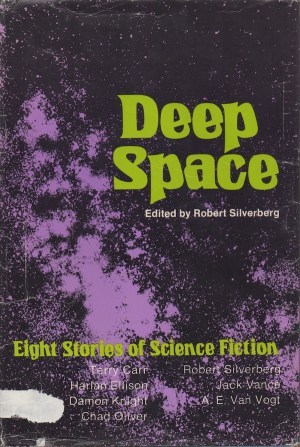
Classic Adventures in Deep Space

My local library system, to make room for never-ceasing influx of new sci-fi, frequently discards rarely read gems which I pick up for a quarter. I’ve managed to snag a half-dozen books from David Pringle’s famous mid-80’s list of the 100 best science fiction novels, and a volume of first-rate C.L. Moore stories, among others. Here’s another gem that might be easy to miss: Deep Space, a collection of mostly 1950’s stories about, you guessed it, deep space. Despite the lackluster cover, this collection has some first-rate stories, including early ones by Harlan Ellison and Gordon Dickson, and a psychedelic planet story from Jack Vance that is even better than the Dying Earth stories. Continue reading “Classic Adventures in Deep Space”

Sunday Poem

This week’s poem is Mary Oliver’s “Imagine”, which places imagination and wonder at the heart of our efforts to understand the world. At its best, science capitalizes on imagination and wonder, and becomes a fulfilling pursuit whether you are a professional or not. In the absence of those essential, fundamental traits, science as a job becomes a stifling activity that does not repay the opportunity costs of its pursuit.

I don't care for adjectives, yet the world 
   fills me with them.
And even beyond what I see, I imagine more. Continue reading "Sunday Poem"