
Boring, soul-crushing routine tasks are unavoidable in science

Aspiring scientists need to know that a science career is not an exception to the universal requirement for routine drudgery that applies to all real jobs:

Back in my freshman year of college, I was planning to be a biochemist. I spent hours and hours of time in the lab: mixing chemicals in test tubes, putting samples in different machines, and analyzing results. Over time, I grew frustrated because I found myself spending weeks in the lab doing manual work and just a few minutes planning experiments or analyzing results. After a year, I gave up on chemistry and became a computer scientist, thinking that I would spend less time on preparation and testing and more time on analysis. Continue reading “Boring, soul-crushing routine tasks are unavoidable in science”
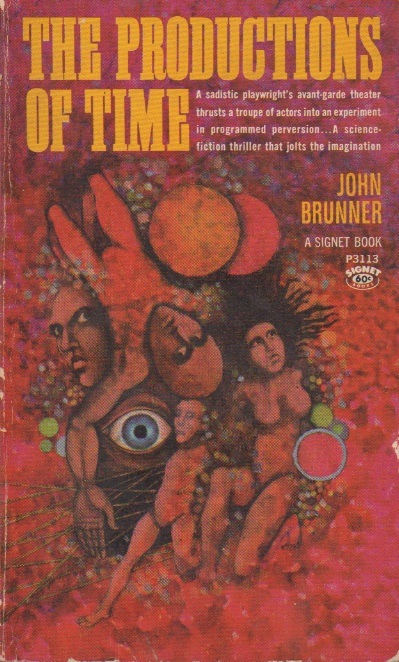
John Brunner’s mediocre Productions of Time

I’ve been drowning in job proposal/manuscript writing this month. I did manage to finish one of the growing stack of vintage science fiction weighing down my shelves: John Brunner’s The Productions of Time (1966), which sounded fun, but ended up disappointing.

Murray Douglas is a famous but washed-up actor, just out of rehab for alcoholism and trying to get back into theater. He gets recruited for an odd play project designed by an enigmatic Latin American playwright Manuel Delgado, whose past works have led to suicides and institutionalizations of the actors involved. Murray and the cast are kept in a lavish country club to work out the play, but Murray soon realizes that the theater project may be secondary. Delgado and his staff have rigged the place up with mysterious electronic devices that may be for eavesdropping, and and Delgado seems to be deliberately stoking to the sexual and narcotic vices of the oddly passive cast. Continue reading “John Brunner’s mediocre Productions of Time”

This week’s Nobel Prizes have simplified my talk introductions

For my entire scientific career, I’ve introduced every talk with one of the following arguments:

1) G-protein coupled receptors are fundamentally important and interesting because they are involved in almost every aspect of our physiology, and because they are the targets of the majority of currently used drugs.

2) Gene regulation is fundamentally important and interesting because it is involved in almost every major biological process, including development, cell division, and differentiation, as well as disease.

Now I can skip all that and say:

1) GPCRs are important and interesting, and the Nobel Prize for Lefkowitz and Kobilka proves the Swedish Academy agrees with me.

2) Gene regulation is important and interesting, and the Nobel Prize shared by Yamankana proves the Swedish Academy agrees with me.

My hearty congratulations to the winners.

Skeptically Speaking about ENCODE

The latest episode of Skeptically Speaking is out, where you can listen to host Desiree Schell talk to WIRED writer David Dobbs about Naomi Wolf’s latest book, and to your truly about the disastrous media coverage of ENCODE. Listen online, grab it in podcast form, or find on one of the many radio stations that carry the show.

A big thanks to Desiree and producer K.O. Myers for having me on the show, and helping me sound less incoherent than I might have.

I’ve got two clarifications on some dates I tossed out during the interview:

I said ENCODE has been going for at least five years. I was thinking of the post-pilot phase, which began in 2007, after the pilot phase publications. ENCODE itself began in 2003.

I said people have been studying transposable elements for at least 30 years. I had in mind the 1980 papers on selfish DNA by Orgel and Crick and Doolittle and Sapienza. But of course don’t forget that Barbara McClintock discovered transposable elements in the 40’s and 50’s, and won her Nobel Prize on the subject almost 30 years ago.

Has ENCODE redefined the meaning of ‘gene’?

While I’ve been criticizing how ENCODE has been hyped and spun, it’s useful to take a look at the situation from the perspective of someone within the consortium. Why are the ENCODE findings supposed to be so revolutionary?

John Stamatoyannopoulos, who has made some of what I see as the most unjustified statements to the press on the topic of ENCODE, lays out his views on the significance of ENCODE in this piece. (Genome Res. 2012. 22: 1602-1611)

He argues that the view of the genome emerging from ENCODE (and, I must emphasize, from the work of other scientists who have used and developed similar technologies, but are not part of the consortium), thanks to its unprecedented detail and global perspective, has radically changed our understanding of just what a gene is. (But have we ever settled on what is a gene?) Continue reading “Has ENCODE redefined the meaning of ‘gene’?”