2015 science festivals around the world

Want to travel the world visiting science festivals? You could, if you wanted to.

The first major science festival of the year is already over. Techfest (Asia’s largest science/tech festival) ran from January 2 to 5 in Bombay, India. It’s an annual event, so consider this a heads-up for 2016.

Below is a list of science festivals for the rest of 2015. It doesn’t include all science festivals – there are way too many. Instead, it lists some throughout the year, across the world, including some of the biggest ones. For a more complete list see this 2011 post on Schemes and Memes.

February

March

April

May

June

July

August

  • 2015 date tba – Geek Picnic – St Petersburg, Russia

September

October

November


I challenge you to visit all of them! (Good luck on May 9…)
Garbage – Part 2: Earthships

Part two of my garbage-themed science travel series. This week, a place I visited after seeing it on a documentary.

4937828296_f9f887c202_zIn 2007, I saw the documentary Garbage Warrior at its premier at the Hot Docs film festival, and three years later it inspired a detour to Taos on my way to a conference in Albuquerque.

Garbage Warrior tells the story of Michael Reynolds, a renegade architect who developed a way to build sustainable homes out of garbage. It sounds crazy, it sounds disgusting, but the homes are beautiful and the way they are designed, built, and developed is experimental in not just the architectural sense, but also scientifically experimental: They try things, and if it doesn’t work, they change parts until it does work. Reynolds’ early customers didn’t always understand that aspect of “experimental” and complained when things didn’t work, but over time the buildings have become better and better.

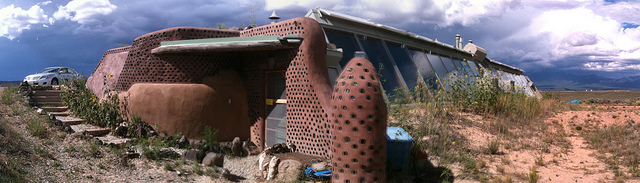
The houses are called Earthships, and this is what they look like:

4937172455_f1b9756508_z
I stayed in this particular Earthship for one night in 2010, in between two conferences. I wrote up my experiences for WorldChanging Canada at the time, so you can read a bit more there as well. Continue reading “Garbage – Part 2: Earthships”

Garbage – Part 1: Pacific Garbage Patch

Two of the most interesting science-related destinations on earth are both garbage-related, so get ready for a garbage-themed two-part post.

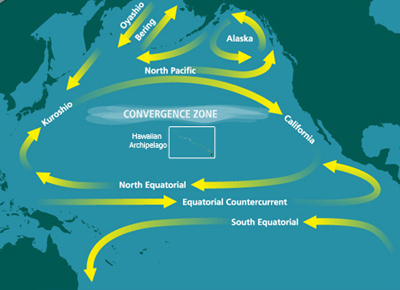
Remember the duckies that floated around the oceans for years? Ocean currents brought them all the way across the Arctic. But ocean currents don’t always push garbage to shore. The currents also create large vortexes from which floating plastic can’t escape. Instead, it all stays within the vortex, and creates a patch of floating waste in the convergence zone.

Marine Debris Poster (4) AI9

This is what happened at the Pacific Garbage Patch.

Despite some photos you may have seen, this is not a large patch of floating objects. (In fact, I can’t find ANY reliable and reusable photos of what it ACTUALLY looks like, so you just get a map.)

Unlike the duckies, which retained their duckie shape throughout their oceanic travels, the majority of the plastic in the Pacific Garbage Patch is not shaped like any recognizable objects. It’s mainly plastic pellets, down to microscopic size. The water can look relatively normal on the surface, but water samples consistently show plastic.

As Miriam Goldstein describes in an interview with io9, it’s not entirely clear what the effect is of so much plastic in the ocean, but it’s definitely changing the ecosystem.

It’s also very difficult – logistically – to clean up plastic from such a large and remote area. It’s not close to any particular country, and the garbage comes from everywhere, so whose job is it to clean?

The best solution, of course, is to prevent garbage from ever ending up in the ocean in the first place, and next week I’ll take you on a virtual trip to a place where household waste is being reused in a unique way.

Map from Wikimedia, in the public domain.

Nikko Natural Science Museum

IMG_2558A few years ago I was in Japan for a conference, and tagged on some extra days to explore a bit more of the country together with my sister. We mostly stayed in and around Tokyo, but we took a two-day trip to Nikko, further inland. Nikko is a small town with a beautiful heritage site, with lots of temples, and a famous wood carving of the original “see no evil, hear no evil, speak no evil” monkeys.

Close to Nikko, just a 20-minute bus ride away, is a waterfall that all the guidebooks recommended, so we had to check it out. The waterfall is further uphill, at Lake Chuzenji – a lake formed after a volcanic eruption blocked off the river thousands of years ago.

Before we got on the bus, we became a bit worried by the fog we had seen creeping onto the mountain. Hoping that it would clear eventually, and with no further days left in Nikko, we decided to risk it and journeyed to Lake Chuzenji.

The further we travelled up the mountain, the thicker the fog got.

Once we got out of the bus at the top, we walked toward the waterfall, barely seeing more than about twenty or thirty feet in front of us.

In the distance, we saw what looked like a… bear?

Coming closer, the bear stayed motionless next to a sign. It was a wooden statue.

IMG_2544

The sign was for the Nikko Natural Science Museum, but we were aiming for the falls, so we didn’t stop at the museum.

Last week, more than two years after visiting the Lake Chuzenji area, I was looking at my photos again, and decided to look into this Natural Science Museum that the bear was trying to entice us to visit.

Continue reading “Nikko Natural Science Museum”

AMNH Shelf Life

I’ve never been to the American Museum of Natural History (it’s on the “to visit” list!) but now the museum is coming to me via the magical medium of YouTube. AMNH has launched a video series called Shelf Life, through which you can get a behind the scenes tour of parts of their collection.

The show debuted in November, with an episode on collections in general (and fish in particular). Two more episodes have since gone up, one per month. The production quality of the videos is really good, but they managed to stay within the YouTube attention span.

The most recent episode is about the coelacanth, which actually ties in nicely with my last post about the Tiktaalik, so you might want to watch that.

I can’t help but wonder, though, if they modeled it after the Field Museum’s (acquired) Brain Scoop series, but it is clearly a different concept, with different people on screen in every episode. Each episode is also accompanied by a web page with more information, so it’s more in depth than just the videos. I really liked the turtles and taxonomy episode and web page.

It’s good to see another museum embrace online video to share their collection, and I can’t wait until February’s episode, which is all about the olinguito!