The interwebs have been abuzz this week about a new technique published in Nature coming from the Deisseroth Lab at Stanford (formerly of optogenetics fame). Now he’s the optogenetics guy AND the CLARITY guy, come on Karl leave something for the rest of us! Anyway, the new method allows entire brains, that have been removed from their respective skulls, to be processed into hydrogel hybrids that are optically clear and able to be labeled and observed all the way to their very center. This video is an example of a CLARITY processed mouse brain that is labeled with Thy1-GFP (green fluorescent protein expressed in ~10% of neurons). You can see individual neural cell bodies (the small round dots) and the projections from individual neurons (long thin fibers). Continue reading “Clear brains you say??”
Image of labeled (red) DNA breaks in a single cell courtesy of the Journal of Cell Biology
Do you ever think about how every time you encounter something new your brain adjusts and rewires and makes molecular changes so you can remember this new object in the context of what you already know? I know I do, though that may be a by-product of my neuroscience upbringing. Even if you don’t think about it, it’s happening. Complex changes in the numbers and amounts of gene expression are critical to developing and maintaining memories. And as it turns out, breaking the DNA in your brain cells into pieces is also part of the process.
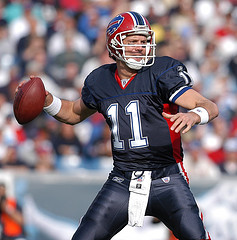
Last week the NFL announced their Head Health Initiative, a 4 year $60 million dollar collaboration to improve diagnosis and recovery from potential head injuries. $40 million dollars will go towards developing imaging technology to better detect trauma in head injuries and $20 million will be devoted to the study of concussions including understanding, diagnosing, and treating them. Continue reading “NFL moves to protect player’s brains”
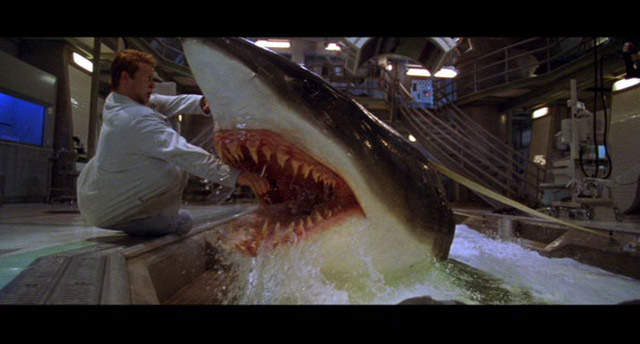
I don’t know if you’re familiar with the cinematic gem Deep Blue Sea, but as far as ridiculous neuroscience sci-fi horror movies go, it is awesome. Let me summarize the plot for you. A group of researchers is working in an underwater lab trying to cure Alzheimer’s. Their proposal involves genetically engineering three Mako sharks to enlarge the size of their brains. Somehow, the researchers plan to harvest these huge brains and then use the tissue to cure Alzheimer’s… Lets just say, they didn’t cure Alzheimer’s and spoiler! Samuel L. Jackson gets eaten in one of cinema’s greatest death scences. Continue reading “Smarter mice are safer than smarter sharks”
Memoto CEO Martin Kallstrom with the Memoto camera. Photo by Johan Lange
Do you ever get to the end of a whirlwind trip and wish you could actually remember what you did? I’m guessing many of you who attended ScienceOnline2013 have forgotten as much awesome as you remember about the conference. What if there was a way to record your days for nostalgia’s sake or to monitor your lifestyle? You are in luck! This week at South-by-Southwest (SXSW) a Swedish start-up is pitching their tiny wearable camera called Memoto.
Memoto takes two geotagged photos each minute from its position on your collar, on a belt loop, wherever you decide to clip the tiny weather-proof camera. The camera’s battery can last several days and it recharges when you plug the camera into your computer to download all of the pictures taken since the last sync. Now you can record all the moments of the day that you might not think to whip out your smartphone to record. The camera isn’t automatically linked to social media platforms yet, but that functionality is on the horizon.
I think this particular functionality could really test the limits of personal privacy. I personally don’t want two photos per minute of me posted to facebook while I have a conversation with someone. It can also be a huge infringement on patient privacy should someone wear this camera into a hospital and end up imaging someone’s private health information and potentially posting it to the web or even storing it on a server somewhere. Are medical practices even aware that this sort of thing exists?
Another issue linked with the type of data volume (120 photos per hour!) this camera would generate is storage. Memoto offers a remote server storage program for all of your images but it isn’t clear how secure your data will be. Memoto has several blog posts about data security but no firm policy in place yet. Would you be willing to risk having the images of your life exposed to anyone with the gumption to hack into those servers?
The idea of self-tracking is really intriguing but,I think I might be depressed to know how many photos a day are of my computer screen.


 The Finch and Pea