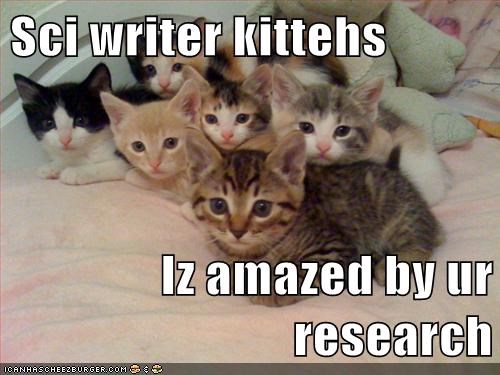
Thousands of science kitties have gathered in Chicago this week for the AAAS Annual Meeting, where they get together to discuss the latest research on catnip addiction and hold panels on the causes of dogs’ inability to read. You can follow along on twitter with hashtag #AAASmtg or see some sessions live-streamed online.
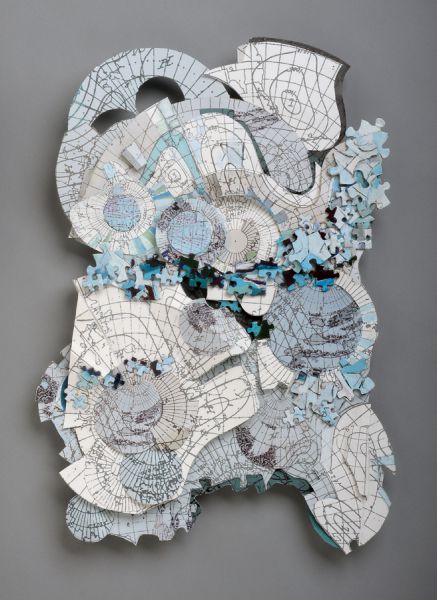
Northern Waters, by Massachusetts-based artist Phyllis Ewen, is a series of sculptural drawings looking at water as “a life force that resist being controlled.” Ewen builds her 3D images by scanning maps, charts and photos and then cutting them and building them into layers, adding paint and text, most recently in puzzle-piece shapes.
Ewen’s work explores the ways in which “life-giving waterways have been contested, diverted, polluted, and exhausted by human intervention.” In the case of Northern Waters, the oceans and glaciers are being profoundly reshaped, not by the obvious interventions of dams and agriculture, but by the effects of human-caused global warming.
Some of Ewen’s sculptural drawings are included in a global-warming themed exhibition called Thaw, at the Dorsky Gallery in Long Island City, NY, through April 6. You can see lots more of her work at her website.
Over the last several years, scientists have made huge strides in understanding the microbiome – that is, the community of microorganisms populating our air, water and soil, as well as our bodies. In a blogpost this week, UC Davis biologist Jonathan Eisen draws attention to two new studies of the microbiome of the built environment – one on the microbial profile of a hospital NICU and one on the relationship between architectural design and the biogeography of buildings.
Eisen points out that a thorough understanding of microbial environments is crucial to changing the widespread fear of microbes, most of which are not only not harmful, but possibly crucial to maintaining healthy living spaces. He points out, “Just as we would not argue for killing all mammals simply because one might be annoying us, we need to stop trying to kill all germs just because some do us harm.”
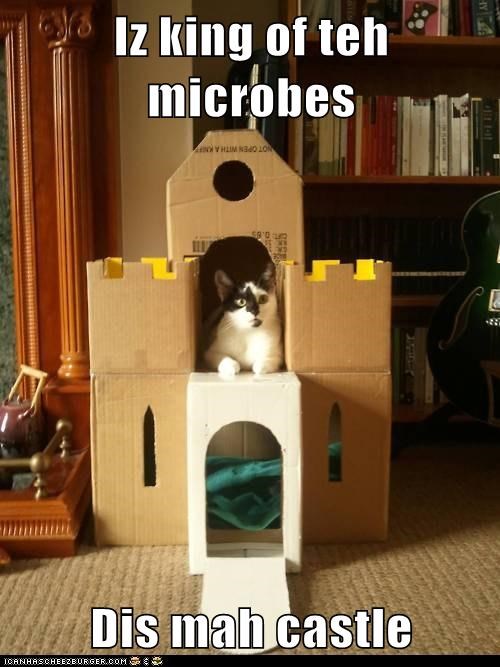
Since it’s Caturday, we should point out that, besides being a very smart guy, Jonathan Eisen is a friend of kitties (evidence). He has served as a senior advisor on the not-terribly-serious Kitten Microbiome Project and also compiled a handy list of more rigorous scholarship on kitty gut bug microbiology on Mendeley. And he provided us with a great excuse to re-use these lolcats.
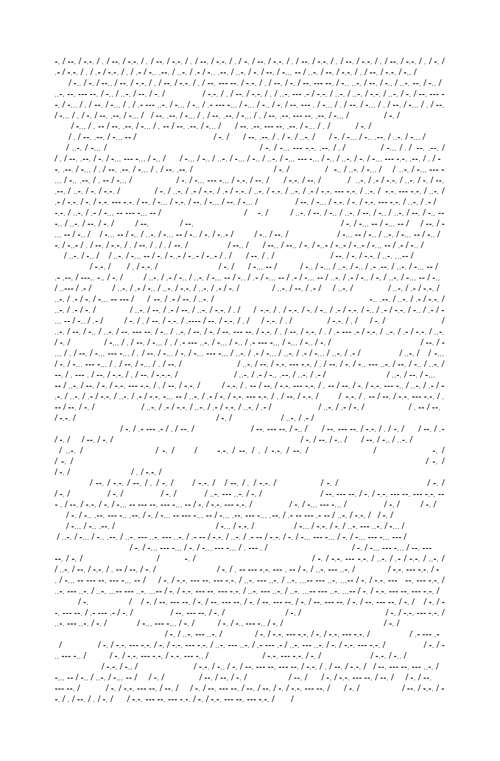
Some of The Moonlight Sonata as received in code from the moon. Katie Paterson, 2007
For centuries, artists have been inspired by the beauty and mystery of the moon, and for the last 50 years, by the tantalizing possibility of traveling there. An exhibition in London, The Republic of the Moon, takes those imaginings a few steps further. The show, at Bargehouse in London’s South Bank, “combines personal encounters, DIY space plans, imaginary expeditions and new myths for the next space age,” says its organizer, Nicola Triscott of The Arts Catalyst.
One especially intriguing piece is a sound and data based work called Earth – Moon – Earth, by Scottish artist Katie Paterson. Paterson translated Beethoven’s Moonlight Sonata into Morse code and “bounced it off the moon” via Earth-Moon-Earth (EME) transmission. The artist explained: “The moon reflects only part of the information back – some is absorbed in its shadows, ‘lost’ in its craters … Returning to earth fragmented by the moon’s surface, it has been re-translated into a new score, the gaps and absences becoming intervals and rests. In the exhibition space the new ‘moon–altered’ score plays on a self-playing grand piano.” (You can listen to a clip of it here)
(Full disclosure: I thought Paterson was totally making this EME stuff up. A brief consultation with my friends Google and Wikipedia, however, convinced me that it is indeed possible to bounce a signal off the moon’s surface and people have been doing so since the 1950s. Incidentally, streaming Beethoven to the moon sounds like a perfect project for noted music-and-moon-lover Newt Gingrich. But I digress. )
Is Paterson’s piece a metaphor for the cultural loss that often seems to go hand-in-hand with scientific progress? Maybe. It’s also intriguing that she chose Beethoven, not only for the “moonlight” theme, but because he couldn’t even hear all the notes himself.
If you’re in London, you have a few more days to catch The Republic of The Moon before it closes on February 2nd. You can also see her work in upcoming shows in Berlin and Adelaide, Australia or on her website.




 The Finch and Pea