Science Caturday: Spring haz Sprung

nomoresnow

The vernal equinox on March 20 marked the official arrival of spring in the northern hemisphere. And after the harsh winter that many of us experienced this year, it arrived none too soon.

needtoshave

Only if you want to, kitty! Relax and enjoy the first Caturday of spring.

lolcats via Cheezburger.com

The Art of Science: Fashioning Cancer

fashioning-cancer-770

As a big proponent of showing your inner beauty by wearing your cells and microbes on the outside, I couldn’t help but be excited by this collection of ball gowns inspired by microscopic photos of cancer cells created by Jacqueline Firkins.

Firkins, a professor at the University of British Columbia in Canada, says, “Many women who have battled cancer express a disconnect with the fashion imagery that commonly represents the disease,” such as the ubiquitous pink ribbon for breast cancer awareness. Firkins hopes that her collection, titled Fashioning Cancer: The Correlation between Destruction and Beauty will encourage discussions about disease, body image and beauty.

The cell patterns on the dresses were inspired by images captured by researchers in the lab of UBC scientist Christian Naus.

“My hope is that somehow through fashion, I more closely tap into what a woman might be feeling about her body as she undergoes the disease, but simultaneously reflect a strength, beauty, and resilience,” says Firkins, who will use the collection to raise money for cancer research, patients and survivors.

A free public presentation and discussion of the Fashioning Cancer collection will take place March 25 at noon at UBC’s Frederic Wood Theatre. More information is here.

Photo by Tim Matheson via UBC News

Science Caturday: Say Ohai to Nanuqsaurus

nanuq

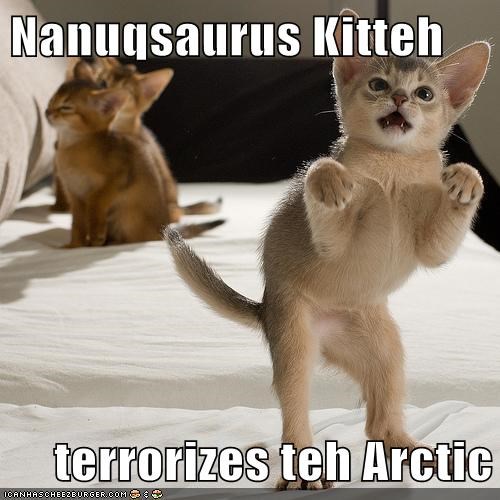
It’s always exciting when scientists discover a new dinosaur, especially if it’s a cute little one.  As Brian Switek reported in National Geographic’s Phenomena this week, paleontologists Anthony Fiorillo and Ronald Tykoski have named a smallish tyrannosaur that once lived in the Arctic.

The scientists gave the dino the name Nanuqsaurus hoglundi –combining the Iñupiaq word for polar bear and a philanthropist named Forrest Hoglund.  The incomplete skeleton unearthed in northern Alaska indicates that, although Nanuqsaurus was likely fairly closely related to Tyrannosaurus rex, it was much smaller, around 25 feet in length compared to 40 for a T. rex.

Perhaps the most astonishing aspect of the recent discovery: photographic evidence (above) indicates that some traits of Nanuqsaurus may have somehow veered from their branch of the phylogenetic tree and taken up residence in cats, rather than birds. We await further study.

Photo: Cheezburger.com

Liek Dinos? Brian Switek’s ossim book, My Beloved Brontosaurus, is just out in paperback. You can haz.

The Art of Science: A Machine that Vends DNA Samples Like Candy Bars

singlepack2
Gabe Baria-Colombo, DNA Vending Machine, 2013

Gabe Barcia-Colombo’ s DNA Vending Machine is an art installation blending the utterly mundane (a fairly primitive machine dispensing mostly crappy snack food) with the cutting-edge (DIY human genetics) to intriguing effect.

Barcia-Colombo, a 2012 TED fellow, collected DNA samples from a bunch of his friends using a basic swish-and-spit method. With the help of Oliver Medvedik of GenSpace, a community biotech lab in New York, he synthesized the samples in a liquid base.  Barcia-Colombo then created a pack-of-cards sized case for the vials and loaded them into a vending machine.

As the picture above indicates, the only labeling on the vials is a number.  Barcia-Colombo compares this to the concept of “blind box” collectible toys – sealed limited edition collectible figurines packaged randomly with many variations. As with human genetics, people have limited information on which to base their choices, and much depends on luck.

Each sample comes packaged with a collectable portrait of the human specimen as well as a unique link to a custom DNA extraction video. The DNA Vending Machine treats human DNA as a collectible material, exploring the question of who owns our DNA.  Can the person who bought a stranger’s DNA from a vending machine get it sequenced or potentially use it in other ways?

The DNA Vending Machine has been shown in several galleries, and the artist reports that many people have indeed bought the DNA samples. No word on what they’ve done with them – yet.

hat tip: DesignBoom

Science Caturday: Rocket Cats!

houston

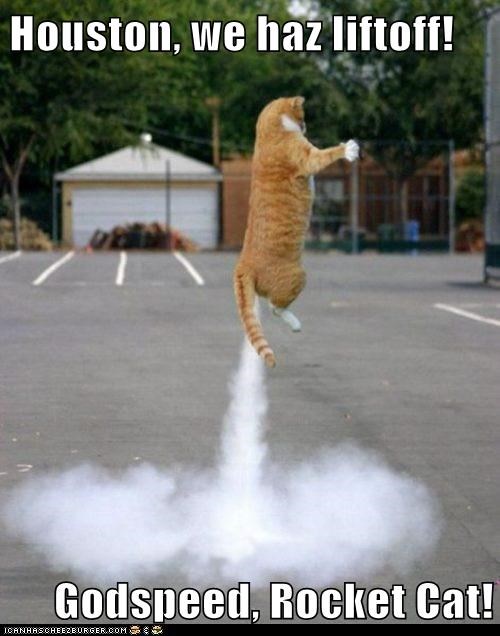
In the headlines this week: 16th century rocket cats. That’s right, experts recently revealed that a military manual dating from around 1530 imagined the use of cats and birds as weapons of war, with gunpowder-filled “jet packs” strapped to their backs to set fire to enemy castles or cities.

According to this article in The Guardian, the academics studying the manuscript believe that cats would be poor weapons. Given their preference for staying close to home and doing pretty much as they please, a gunpowder-toting kitty would be more likely to set fire to his master’s camp than to go near a strange castle.

However, the photo above, obtained from a top-sekrit source, indicates that some testing of rocket cats may have been carried on long after castle walls fell, and may indeed be going on to this day.

Image via cheezburger.com