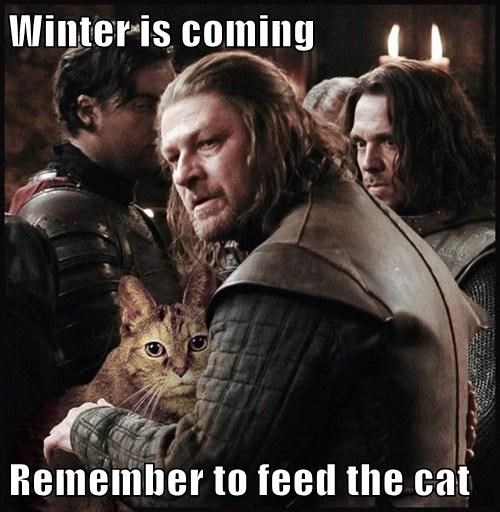
Really, who needs science when you’ve got dragons? But if you want both, check out this article by Marc Lallanilla all about the science of Game of Thrones, including handy explainers on incest, wildfire, and never-ending seasons.

Really, who needs science when you’ve got dragons? But if you want both, check out this article by Marc Lallanilla all about the science of Game of Thrones, including handy explainers on incest, wildfire, and never-ending seasons.

You know how the horizon makes a more or less straight line across every landscape? I saw a series of art photos of glaciers last night by Caleb Cain Marcus at the National Academy of Sciences that buck the convention. Although he’s shooting landscapes, Marcus messes around with the composition of his photographs so that he eliminates the horizon – you just get craggy bits of ice and then a big expanse of sky. As the NAS blurb about the show expresses it: “Freed from the horizon, a sense of scale is lost, altering one’s experience of a landscape. It is in this unfamiliar territory that Cain Marcus hopes viewers can fully experience the persona of ice.”
But here’s the weird thing: I saw this artwork just a few days after watching Cosmos, the episode where Neil DeGrasse Tyson pointed out that, because we’re on a round planet spinning through a constantly moving universe, that line that we see as the horizon isn’t actually there. The line is a lie.
So, in making his pictures of glaciers more abstract by eliminating the horizon, Marcus is actually making them more real. And I think I just blew my own mind.
You can see the show at NAS through July 18 or see more images on Marcus’ website.
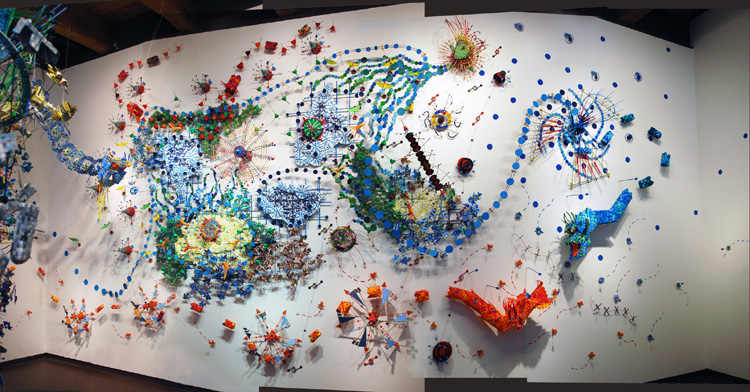
I’ve featured several artists here who incorporate weather data in their work, but nobody who does it with quite the mix of over-the-top exuberance and scientific rigor as Nathalie Miebach. As Miebach explains, “My work focuses on the intersection of art and science and the visual articulation of scientific observations. I translate scientific data related to astronomy, ecology and meteorology into woven sculptures.”
Yes, woven – the material basis of her art is basketweaving, a highly traditional form not usually used in data visualization.
Miebach hopes that her artwork expands the visual vocabulary of scientific data, moving far beyond charts and graphs. She says that science teachers were among the first to embrace her work.
“On one side, my work is very didactic, almost like a graph that tells exactly the relationship between variables, a very scientific representation. On the other, it’s a fanciful, magical, crazy expression of weather that still uses data as a source of material, but has crossed a boundary.” (source)
The piece shown above, part of a show called “Changing Waters” looks at the meteorological and oceanic interactions within the Gulf of Maine. Using data from NOAA and GOMOSS buoys within the Gulf of Maine, as well as weather stations along the coast, it explores the seasonal variations of marine life through a colorful swirl of carefully plotted pieces of weaving.
Some of Miebach’s more recent work has incorporated whirling structures that evoke the fairground rides destroyed by Superstorm Sandy, and her latest pieces are accompanied by original music, which is also based on weather and climate data.
You can see more of Nathalie Miebach’s artwork in a number of current and upcoming shows as well as at her website.

This week, astronomers made two exciting discoveries: the first is a ring system surrounding an asteroid named Chariklo, which orbits in a region between Saturn and Uranus. This surprising finding makes Chariklo’s the fifth known ring system in our solar system , joining Jupiter, Uranus, Neptune and Saturn, and the first known to have formed around an asteroid.

The second major find is a distant, icy dwarf planet in the far reaches of the solar system, 7.5 billion miles from the sun. The object, officially known as 2012 VP113, measures about 280 miles across. It’s extremely cold with a temperature of around minus 430 degrees Fahrenheit and is reported by astronomers to be faint and pink, making it hard to detect.
Our thanks to Kibbles kitteh and Mr. Boots for playing the roles of Chariklo and VP113 so graciously.
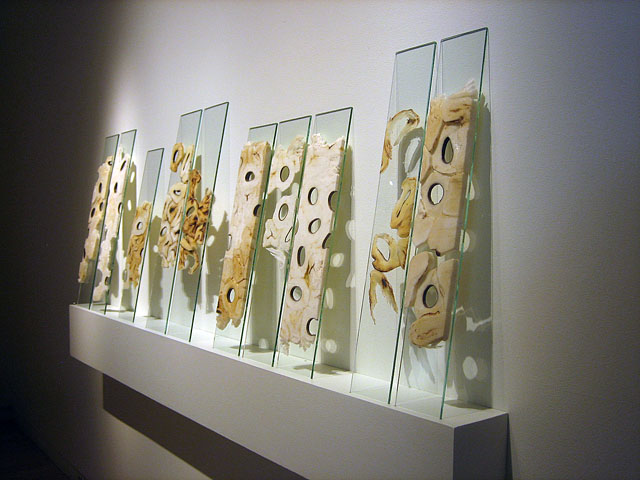
I spotted a wall sculpture by Jessica Drenk recently at the Adah Rose Gallery in Maryland. The piece attracted me because it looked like osteocytes, a type of bone cell that I’ve featured before in my paintings. It took several more glances before I realized that these particular cells were, in fact, made of rolls of toilet paper.
As it turns out, this is exactly Drenk’s oeuvre – taking common, manufactured items and transforming them back into the building blocks of nature. In addition to toilet paper, she has used pencils, books, mop heads, Q-tips, coffee filters and PVC pipe to create familiar yet unfamiliar versions of natural forms, from rock formations to nerve cells.
As she describes her work: “By transforming familiar objects into nature-inspired forms and patterns, I examine how we classify the world around us. Manufactured goods appear as natural objects, something functional becomes something decorative, a simple material is made complex, and the commonplace becomes unique. In changing books into fossilized remnants of our culture, or in arranging elegantly sliced PVC pipes to suggest ripple and wave patterns, I create a connection between the man-made and the natural.” (source)
Her work is currently on view in a group show at the Seager Gray Gallery in California and will be featured in a solo show at the Adah Rose Gallery in Kensington, MD next month. You can see lots more at her website.
 The Finch and Pea