Scientists have discovered a new kind of mushroomy, jellyfishy type thingie that nobody had ever studied before. A paper published this week in the journal PLOS ONE describes the discovery of the previously unknown creatures off the coast of Australia. Lead author Jean Just, of the Natural History Museum of Denmark, admitted “we don’t even know if they’re upside down.”
The animals are described as looking like floppy chanterelle mushrooms but feeling like dollops of gelatin. The two new species described in the study were officially named Dendrogramma enigmatica and Dendrogramma discoides. As yet, almost nothing is known about them, and only 18 specimens have been studied.
Mushroom Cat says “ohai” to his newly discovered cousins.
Jiyong Lee is a glass sculptor whose work plays with transparency and translucency, qualities that he says “serve as perfect metaphors for what is known and unknown about life science.” Lee, who was born and raised in South Korea, was educated in the United States and is now a professor as well as a studio artist, heading the glass program at Southern Illinois University.
For the past few years, Lee has focused on the “Segmentation Series” – a group of sculptures based on cell division and genetics. In his words:
The Segmentation Series is inspired by my fascination with science of a cell, its division and the journey of growth that starts from a single cell and goes through a million divisions to become a life. The segmented, geometrical forms of my work represent cells, embryos, biological and molecular structures—each symbolizing the building blocks of life as well as the starting point of life. The uniquely refined translucent glass surfaces suggest the mysterious qualities of cells and, on a larger scale, the cloudiness of their futures. The Segmentation Series is subtle and quiet yet structurally complex. I transform solid glass using cutting, lamination, carving, and surface refining processes to make art that is both beautiful and deeply invested with meaning.
The piece shown above, Head-Thorax-Abdomen, from 2013, is based on the embryo of a drosophila, or fruit fly. Drosophila are tiny creatures with a lifespan of weeks, but which have played an important role in the study of genetics and evolution. Genetically, they have many similarities to humans, a fact which makes this piece a beautiful example of the profound interconnectedness of living beings.
Works from the Segmentation Series will be featured in a solo show of Lee’s work at the Duane Reed Gallery in St. Louis, MO, from October 24 – November 29. You can see more work by Jiyong Lee at his website.
Big cool microbiologist Jack Gilbert (and a bunch of his smartest colleagues) just published a paper in Science which reveals that, like Pigpen, every human lives in a unique cloud of germs that we carry with us wherever we go.
This microbial profile, or “germ fingerprint”, is transferred to your living space remarkably quickly. “No matter what you do to clean a hotel room,” Gilbert said, “your microbial signal has wiped out basically every trace of the previous resident within hours.”
The study, part of the Home Microbiome Project, sampled seven families, including 18 people, three dogs and a cat. Three of the families moved during the study, so the researchers tested two houses plus hotel rooms for each of them. The volunteers swabbed their hands, noses and feet, as well as floors, counters and other surfaces in their homes.
As nifty as this research is, we strongly disagree with one of Gilbert’s recommendations: he encourages people to get a dog. He told the Washington Post: “We saw dogs acting as a super-charged conduit,” he said, “transferring bacteria between one human and another, and bringing in outdoor bacteria. They just run around distributing microbes all willy-nilly.” Well, of course they do, as they slobber and shed. Science Caturday says:
California has been experiencing drought conditions for over a year, and now geological monitoring stations show that the drying ground is actually rising up. According to this article by Sarah Zielinski in Smithsonian Magazine, “Measurements of these subtle movements, made using GPS instruments, suggest that the western United States is missing some 62 trillion gallons of water, enough to cover the entire region six inches deep.” Alarming news for farmers and thirsty kitties alike.
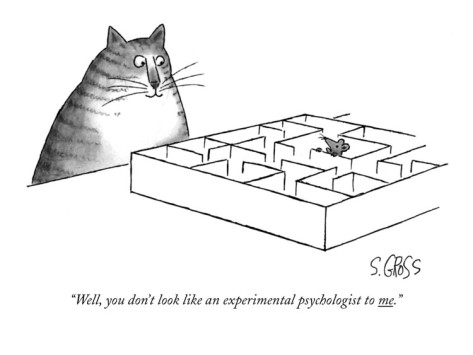
Psychologists from all over the world are gathered this week for the annual meeting of The American Psychological Association (APA2014), so they can haz this cat cartoon, by Sam Gross for The New Yorker.




 The Finch and Pea