Disneyland: the happiest place on earth? Maybe not right now. Health officials have now confirmed 67 cases of measles linked to visits to California’s Disneyland and Disney Adventure Park. The Centers for Disease Control believe that the virus was carried by a visitor exposed to it overseas and that it then spread rapidly among unvaccinated children.
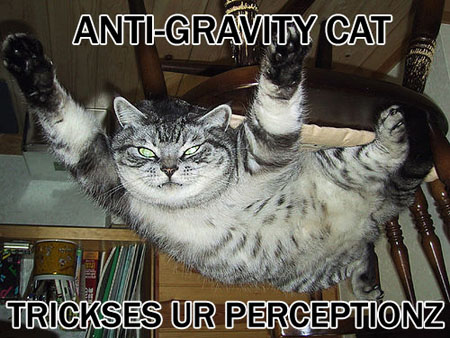
Measles is highly contagious, extremely unpleasant, and can lead to brain damage and even death. So please vaccinate your children – and maybe skip that trip to Disneyland this winter in favor of some fun at home with the cat.
Artist Elsabé Dixon grew up raising silkworms in cardboard boxes as a child in South Africa. Now based in Virginia, Dixon has made her childhood hobby the source of her art, now on display in a unique residency and installation called LIVE/LIFE at Arlington’s Artisphere through February 22.
In the Artisphere studio, Dixon and helpers first constructed an environment for domesticated silkworms (Bombyx mori) to live out a life cycle – hatching from eggs to caterpillars, eating mulberry leaves, spinning cocoons, pupating, mating and dying – and then created sculpture using what was left behind, including twigs, empty cocoons, salt and even silkworm poop.
Detail from LIVE/LIFE, Elsabe Dixon, Mixed Media, 2014-15
Dixon sees the life cycle of the Bombyx mori – the only truly domesticated insect in the world – as a means of investigating many aspects of life. The first and most obvious is the ephemeral and ever-changing nature of life, but the work examines many other issues, including our relationships with society, nature and the built environment.
There are no barriers between the insects and the audience here. Visitors in the earlier months of the residency were free to touch the caterpillars and the moths. When I visited earlier in January, the moths were all dead, but I was able to touch the silk cocoons left behind.
The sculptural installation that Dixon has constructed, first for the silkworms to live in and then using their products and detritus, is based on microscopic photographs of silkworm particles. Made from materials including rubber, cut-up cardboard paper towel tubes, discarded silk cocoons, mulberry branches and, yes, piles of caterpillar poop, the installation looks organic, natural, and utterly at home in its modern-art setting.
LIVE/LIFE is open to the public Thursday and Friday evenings as well as Sunday afternoons, when the artist welcomes visitors to join in conversations with her and others in the field of art, medicine, engineering and food production.
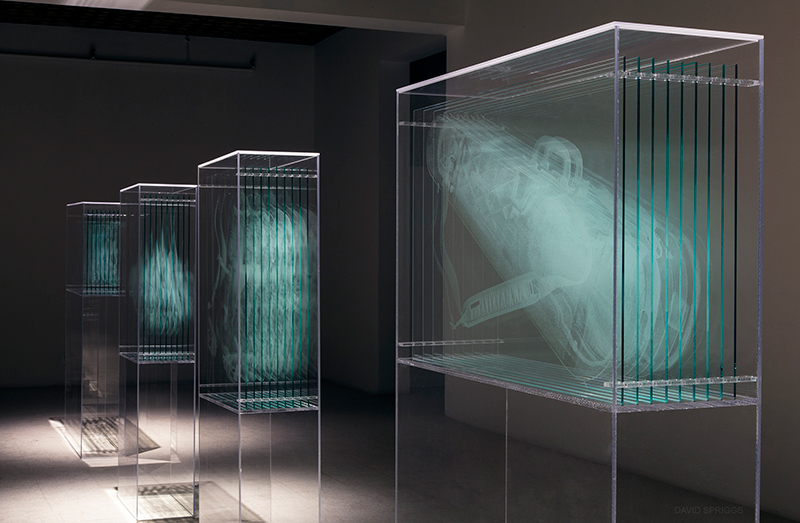
David Spriggs, Profile, Type A – Briefcase, 2014, Glass and Lucite
Transparency, both physical and metaphorical, is the central preoccupation of David Spriggs’ artwork. In his 2014 exhibition, Transparency Report, he took classic 21st-century images of personal possessions inside a security scanner and turned them into haunting and gorgeously crafted art.
Spriggs creates his artwork by layering images in space – in this case by engraving multiple sheets of glass which are displayed in spaced layers in lucite cases to reveal the three-dimensional forms. While we generally link the idea of transparency with openness and honesty, these works reveal a darker side of transparency, in which individuals give governments and corporations the right to literally see through us and our personal belongings.
Spriggs will further explore the intersection of optics and surveillance in an upcoming show entitled Prism – referring to both the optical apparatus and the NSA surveillance program – from January 29 to May 9 at Montreal’s Arsenal Contemporary Arts.
Installation view from David Spriggs, Transparency Report
Both the US National Oceanic and Atmospheric Administration (NOAA) and The National Aeronautics and Space Administration (NASA) released reports this week naming 2014 as the world’s warmest year. According to the NOAA report, the average temperature was up 1.24 degrees Fahrenheit over the 20th century average across all land and ocean surfaces.
NASA’s Gavin Schmidt said that greenhouse gases are responsible for the long-term warming trends, and that even if the entire world stopped emitting greenhouse gases tomorrow, it still would take many years to stall the rising temperatures. But we better get on it soon! It looks as though some kittehs are already beginning to melt.





 The Finch and Pea