
Recently, Mike and I have found ourselves discussing several research studies with supposedly “surprising” results. While the work involved appears solid and the details of the phenomena were certainly amazing, we struggled to understand why the general phenomenon was “surprising”. Amazing, yes. Unexpected, no. After years of such discussions, Mike has asked me to write down Witten’s Rules of Astonishment*. Continue reading “Witten’s Rules of Astonishment”
Author: Josh Witten
http://www.thefinchandpea.com
Cultural relevance
In a post for Convergent Ed, John Romano makes a compelling case for being “with it” as an educator and communicator. He admits to watching TMZ – every night! Why? Because analogies and metaphors are only effective tools if the reference imagery is relevant to your audience.
On the front lines of education, there is no room for intellectual vanity.
Lake Vostok Bacteria & the Power of Social Media
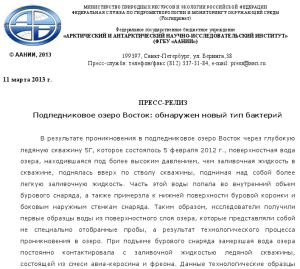
Today, I had to explain to my 4-year-old that Daddy was a little later than usual (I was not “late”) picking her up from school because he was helping facilitate and curate a live tweeted translation/paraphrasing of a press release in Russian (by @PsiWavefunction) about the odd bacteria that may or may not have been discovered by a research program to drill into and investigate a gigantic sub-glacial lake that has been sealed off from the rest of the world for millions of years.
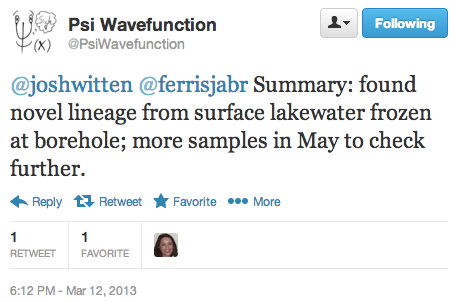
You can follow the translation by PsiWavefunction on the Storify I created as we went. The take home message from the press release was Russian scientists are not incompetent doofuses and:
My daughter’s response? “Antarctica is where penguins and King Cryolophosaurus live!”
Cutting the second slide & Dollo’s “Law”
A recent study on house dust mites has shown that the mighty mites have evolved “in reverse” from an obligate parasite into a free living organism. That is pretty cool. Yet, I find myself in the position once again of questioning the way the research is presented without questioning the quality of the research itself.
For permanent parasites and other symbionts, the most intriguing question is whether these organisms can return to a free-living lifestyle and, thus, escape an evolutionary “dead end.” This question is directly related to Dollo’s law, which stipulates that a complex trait (such as being free living vs. parasitic) cannot re-evolve again in the same form. Here, we present conclusive evidence that house dust mites, a group of medically important free-living organisms, evolved from permanent parasites of warm-blooded vertebrates. – Klimov & O’Connor 2013
The researchers present their result as a refutation of Dollo’s Law, which postulates that evolution is irreversible: Continue reading “Cutting the second slide & Dollo’s “Law””
NatGeo Found: Tumblr achieves its ultimate purpose

National Geographic has created a tumblr blog, Found, showcasing curated images from its archives to celebrate its 125th anniversary. If this is not the blog that tumblr was created to host, I don’t know what is.
 The Finch and Pea