I’ll Trade You an Evolutionary Theory for Your Creationism [Repost]

Originally posted on 31 December 2010, we thought this post was relevant to the social context of the Ham-Nye debate on evolution versus creationism, in particular the value of being “right” on the evidence.

Mixed emotions over PZ Myers’ condescending response to a 12-year-old child‘s email supporting creationism[1], reminded of a very interesting conversation I had with my father at a dinner this holiday season. Lemons and lemonade, people.

During our conversational meanderings, we touched on the debate between creationism[2] and evolution. We did not directly discuss the political/social issues surrounding the teaching of evolution in schools[3].  Rather, we discussed the difficulty of convincing individuals that evolution is right and creationism is wrong. Continue reading “I’ll Trade You an Evolutionary Theory for Your Creationism [Repost]”
Textbooks aren’t always boring

This passage about the discovery of the Spemann organizer from Developmental Biology, 6th Ed by Scott F. Gilbert (2000) not only nails it, but nails it with inspirational style*:

But this research has found levels of complexity far deeper than Spemann would have conceived, and just as Spemann’s experiments told us how much we didn’t know, so today, we are faced with a whole new set of problems generated by our solutions to older ones.

Surveying the field in 1927, Spemann remarked:

We still stand in the presence of riddles, but not without hope of solving them. And riddles with the hope of solution – what more can a scientist desire?”

The challenge still remains.

*…and, admittedly, tortured sentence structure.

UPDATE: Hat tip to my human genetics research partner, Dr. Jennifer Taylor.

Kitchen Wasteland 1

Don’t worry. Mike is still in charge of post-apocalyptic science fiction reviews.

But, let’s face it. Science doesn’t always pay well. Graduate school doesn’t. Post docs certainly don’t. Adjunct teaching? Don’t make me laugh. Science communication can be more feast than famine.

What I am trying to say is that the odds are good that you are living in a small apartment with a small kitchen and on a small food budget. In which case, good friend of The Finch & Pea‘s executive chef, Joel Gamoran, has got you covered in the first episode of his new cooking web series “Kitchen Wasteland”.

Joel was also kind enough to take some time to explain the science behind his recipe to me.

Me: What is happening when you add the pepper to the pan on it’s own?

Joel: The black pepper undergoes two major reactions happening when toasting in the dry pan. First, essential oils are released when agitated with heat. This is what gives the spice the smell that fills the kitchen. Second, oleoresins are released, which gives the spice a toasty and unique flavor.

Me: What is the water doing to soften the pasta and why can you get away with using so little?

Joel: The water’s boiling temperature of 212F triggers the starch molecules in pasta. The pasta swells. It also releases starch into the water making the cloudy thick substance chefs know and love as starchy water. The starch in the water makes the liquid really viscous and it coats whatever it touches. In the case of a pasta dish, it makes a most thick and concentrated sauce that absolutely shames the conventional method of cooking pasta.

Jargon will make time travel very confusing

6c8be9cc69d429e19aa0eb80216d2c91

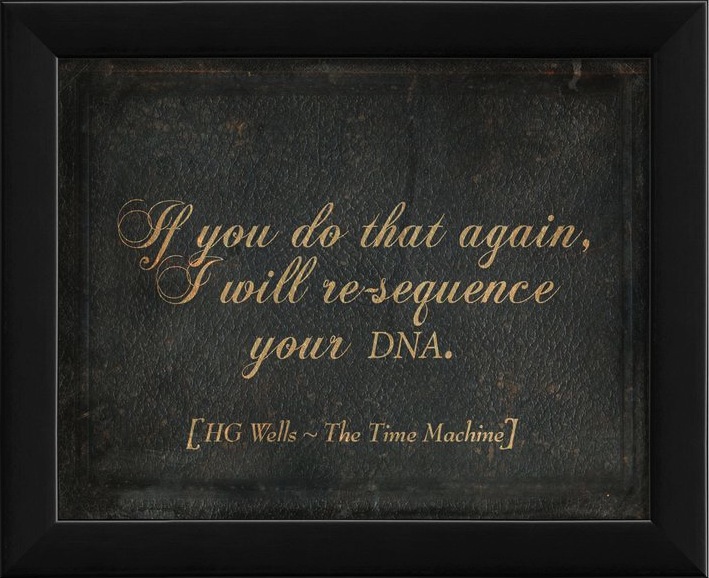
This was a gift from my sister and is a solid science fictiony quote – one that I’m quite happy to put on my wall1.

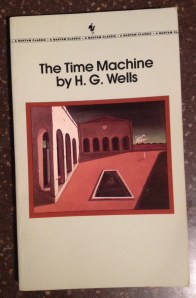
The Time Machine by HG Wells (1991 Bantam Classic Reissue from library of Josh Witten)

Being a fan of, but hardly an expert on HG Wells2 and being a fan of, but hardly an expert on the history of science, I had to wonder if this quote was actually from HG Wells’ The Time Machine, or was from one of the movie adaptations. As you will see, this is an easy question to answer. The trick is figuring out why you might want to ask the question in the first place.

HG Wells was brilliant and reasonably familiar with scientific research. To pen that line, he would also need to be a time traveler himself. Continue reading “Jargon will make time travel very confusing”

JFK on the Sunday Science Poem

Well, not just the Sunday Science Poem. I suppose his remarks could be construed to be about poetry, more generally, and about Robert Frost, more specifically (as the remarks were made in honor of Robert Frost’s passing earlier in 1963):

At bottom, he held a deep faith in the spirit of man, and it is hardly an accident that Robert Frost coupled poetry and power, for he saw poetry as the means of saving power from itself. When power leads men towards arrogance, poetry reminds him of his limitations. When power narrows the areas of man’s concern, poetry reminds him of the richness and diversity of his existence. When power corrupts, poetry cleanses. For art establishes the basic human truth which must serve as the touchstone of our judgment.
President John F Kennedy, Remarks at Amherst College, 26 October 1963

*Hat tip to Greg Proops on The Smartest Man in the World Podcast.