Getting grumpy about PMS paper

On 11 August 2014, Michael R. Gillings published a paper in Evolutionary Applications entitled “Were there evolutionary advantages to premenstrual syndrome?” There is a strain of thinking that is common in the general public, but is also frequently found among academic researchers that I call adaptionism. This line of thinking assumes that, if a biological phenomenon exists, it must be there as the result of natural selection – i.e., be adaptive. This makes things like PMS seem like a great, evolutionary mystery to be “solved”.

Premenstrual syndrome (PMS) affects up to 80% of women, often leading to significant personal, social and economic costs. When apparently maladaptive states are widespread, they sometimes confer a hidden advantage, or did so in our evolutionary past. –from the abstract, Matthew R. Gillings (DOI: 10.1111/eva.12190)

I could spend pages on the problems with this approach to such a question. Fortunately for you and I, Kathryn Clancy, who is far more knowledgable on the relevant evolutionary anthropology than you and I, gutted this paper for The Daily Beast earlier this week:

…the fact that PMS is heritable and variable tells us nothing about whether women with PMS have more children than those who don’t, and this is the true test for adaptation. This crucial point—the third and most crucial condition for natural selection—is absent from the paper.
Kathryn Clancy


Doing the things that a particle can…

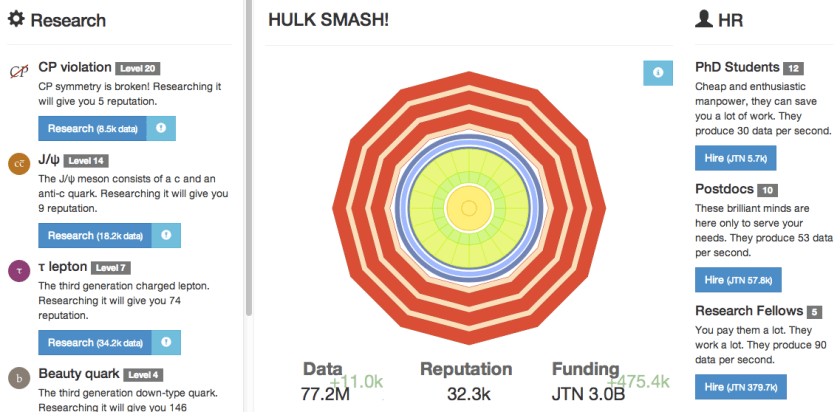
Particle Clicker is a simple and addictive click-based game developed by undergrads at CERN Webfest. You are cast as the head of a particle accelerator lab striving to make breakthroughs in physics, without all the grant writing and begging governments for money.

Screenshot 2014-08-15 21.01.52

In addition to being aesthetically pleasing – I particularly enjoyed the smashed particle paths when you click on the detector, it is full of information about the physics phenomena you are investigating and humor about the research process.

In its current iteration, the gameplay can get repetitive, but it is well worth at least one play through, if only to read all the information boxes. Also, once you have accumulated enough competent staff, you can simply sit back and let the data accumulate while you enjoy the easy life of a high-profile PI1.

NOTES
1. According to reports, this is only an easy life by the standards of graduate students and post-docs with no hopes of advancement on their traditional career path.

SOURCE: Cory Doctorow at BoingBoing.

Sharks are Cool

This infographic from the California Academy of Sciences and Kristen Kong highlights some of the spectacular diversity of sharks as part of their #CelebrateSharks programming. “Celebrate Sharks” helps to promote scientific information and cultivate interest in these amazing creatures at a time when interest in sharks is stoked by the generally unscientific, fear mongering, and deceitful “Shark Week” on the Discovery Channel.

by Kristen Kong for the California Academy of Sciences (All Rights Reserved; Used with Permission)

DISCLOSURE STATEMENT: I’ve always thought the goblin shark was the bee’s knees.

A Network of the People’s Comments on Net Neutrality

The FCC received over one million comments on Net Neutrality. You might remember their website crashing and deadlines being extended. NPR reports the results of an analysis of a subset of the comments by data-analysis firm Quid. Their state by state analysis shows that I’m one of the few people in South Carolina that cares about Net Neutrality.

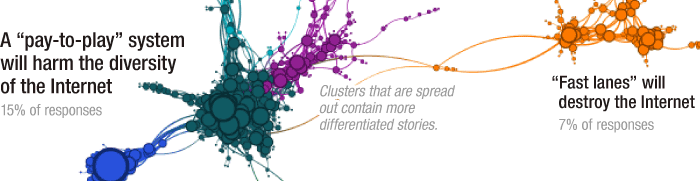
They have produced an even more interesting visual that maps out the diversity of reasons given to support Net Neutrality and how those reasons were linked in the comments.

gr-neutrality-comments-624

Apparently, the few anti-Net Neutrality comments were from form letters and didn’t register on the map.

Although sites like the Electronic Frontier Foundation’s (EFF) web tool provided a template for letters, those were used to generate only about half of the comments (apparently, 80% is more typical for other regulatory issues).

Templates are not unusual. As we’ve reported previously, when the public is asked to comment on policy, citizens often engage by sending in a templated or form letter that advocates for a certain position help them create. The Quid analysis shows about half the comments received by the FCC were “derived from templates.” That’s actually low compared to analyses of other rule-making — upwards of 80 percent of comments on financial regulation were templates. – Elise Hu at NPR


My comment to the FCC, for example, was derived from EFF’s template.

Will this work? Hard to know giving the obstacles faced; but the FCC will clearly be on the record for killing Net Neutrality against the will of the people.

HT: Rob Beschizza at BoingBoing

Science Caturday on Tumblr

Science Caturday (2)Rejoice cat-lovers. We are moving the archive of Science Caturday posts to Tumblr. We haven’t added all the posts yet (turns out we have a lot of cat posts), but Chemistry Cat and the fan favorite “Is alcohol the solution?” post is already there.